







A company’s net profit rises from $536 thousand to $560 thousand in a single year. Good news, right? Oddly enough, its earnings per share actually fell, its receivables ballooned by almost 29%, and it still had to borrow money to buy new machinery.
That is exactly why the four types of financial statements need to be read together, not one at a time. A company’s financial statements consist of the income statement, the balance sheet (statement of financial position), the statement of changes in equity, and the cash flow statement. All four tell the story of the same company from different angles.
For beginners, financial statements can feel like a language from another planet. The easiest way to understand them is to picture our own household finances. Salary minus monthly spending is the “income statement”. The list of today’s house, motorbike, savings, and remaining mortgage is the “balance sheet”. A note on why the family’s net worth went up or down is the “statement of changes in equity”. And the money that actually goes in and out of the wallet and bank account is the “cash flow”.
Understanding the types of financial statements is useful for more than just accountants. Managers, creditors, and investors all rely on them so that decisions aren’t just a case of following the crowd in a WhatsApp group (we’ve all been tempted, haven’t we?).
For practice, we’ll use an imaginary manufacturing company, “danieel.id Company”, based on the book Principles of Managerial Finance (13th edition) by Gitman and Zutter. The figures are in thousands of US dollars ($000), compare 2019 with 2018, and are for learning purposes only.
How Are the Four Types of Financial Statements Connected?
The four types of financial statements are connected through net profit: profit from the income statement adds to equity, the ending equity balance appears on the balance sheet, and the same net profit becomes the starting point for calculating operating cash flow.
Part of net profit is paid out as dividends, and the rest adds to retained earnings, which are then recorded on the balance sheet. The indirect-method cash flow statement also starts from that very same net profit.
In Indonesia, this structure is governed by PSAK 201 Presentation of Financial Statements (the new numbering of PSAK 1), issued by the Institute of Indonesia Chartered Accountants (IAI). To be fair, the standard also requires notes to the financial statements, but this article focuses on the four main statements, because that is where the numbers tell their story.
The table below compares the four types of financial statements by the question each one answers and its key figure for danieel.id Company in 2019.
| Type of statement | Question it answers | Key figure, danieel.id Company 2019 |
|---|---|---|
| Income statement (one period) | Profit or loss over the year? | Net profit $560 thousand |
| Balance sheet (one date) | What do we own and owe? | Total assets $11,025 thousand |
| Changes in equity (one period) | Why did owners’ equity change? | Equity rose to $7,570 thousand |
| Cash flow (one period) | Where did cash come from and go? | Cash up $246 thousand |
In other words, rising profit is not always followed by rising cash, so all four statements must be read as a single story. Let’s break them down one by one.
Income Statement: A Report Card for One Period
The income statement is the type of financial statement that shows a company’s performance over a given period, starting with revenue and then subtracting various costs to arrive at net profit. In a household, it’s the “salary minus expenses” calculation for the month.
The sequence goes like this: revenue minus cost of goods sold gives gross profit, minus operating expenses gives operating profit (EBIT), and after interest and taxes we finally arrive at net profit.
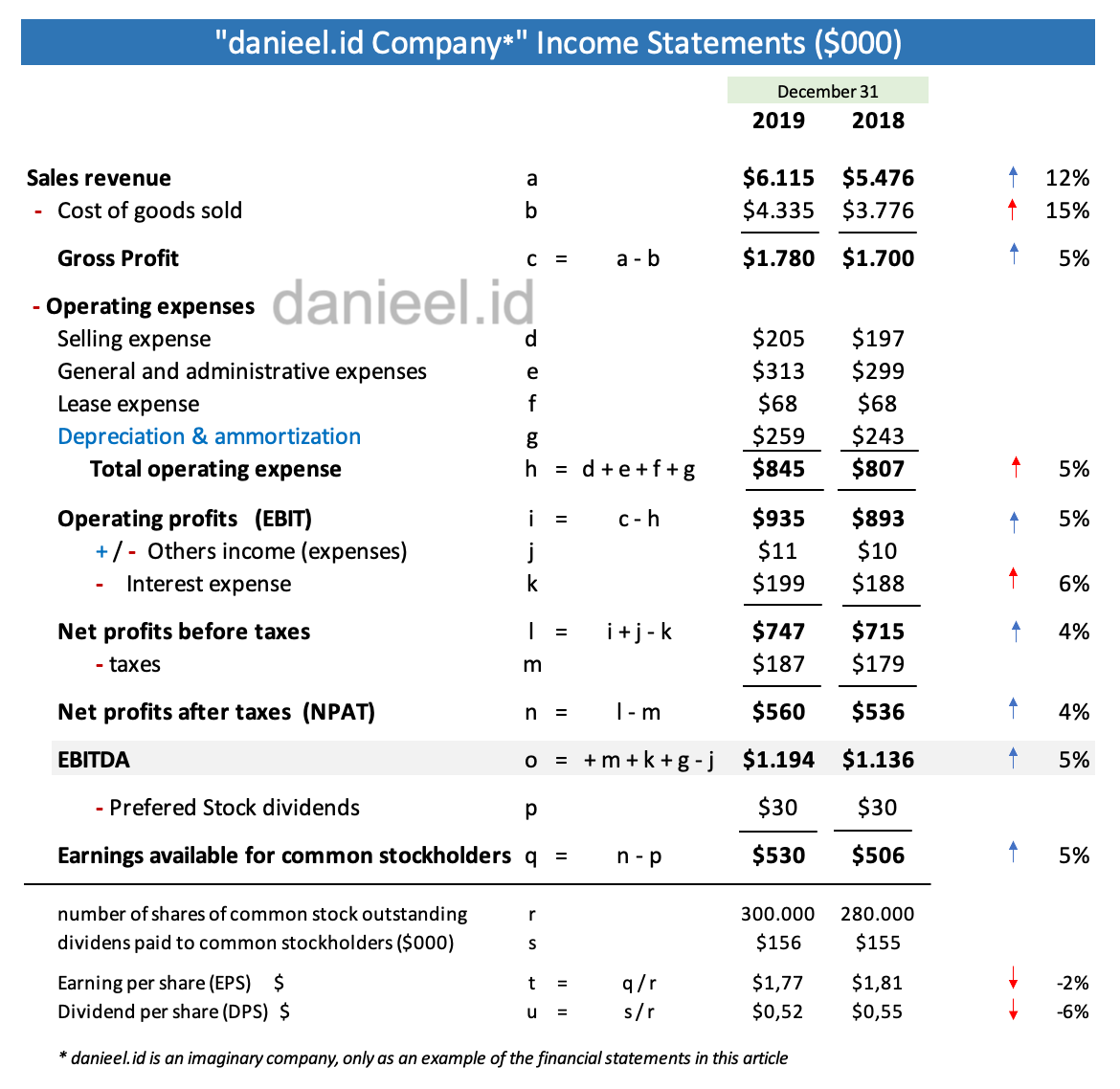
In the danieel.id Company example, 2019 revenue reached $6,115 thousand, up about 12% from $5,476 thousand. However, cost of goods sold grew faster, by about 15%, from $3,776 thousand to $4,335 thousand. As a result, gross profit grew only about 5%, from $1,700 thousand to $1,780 thousand.
A quick review of the income statement
Because danieel.id Company’s cost of goods sold grew faster than its sales, its gross profit margin slipped from about 31% to 29%. The cause could be raw material prices, wages, or an inability to raise selling prices because of competition. This statement doesn’t confirm the cause, but it raises the right question.
The good news is that operating expenses rose by only about 5%. EBIT therefore increased from $893 thousand to $935 thousand. After interest and taxes, net profit rose from $536 thousand to $560 thousand, or about 4.5%. As a rough picture, out of every $100 in sales only about $9 is left as net profit, much like a small shop keeping Rp9,000 out of every Rp100,000 in sales.
What’s interesting is earnings per share (EPS). This figure actually fell from about $1.81 to $1.77 because the number of common shares grew from 280,000 to 300,000. The pie got bigger, but so did the number of people eating it.
The details are in How to Read an Income Statement, while margins, ROA, ROE, and other measures are covered in company financial ratios.
Balance Sheet (Statement of Financial Position): A Snapshot on One Date
The balance sheet is the type of financial statement that captures a company’s position on a specific date: the assets it controls, its obligations to others, and the owners’ claim. If the income statement is a year-long video, the balance sheet is a photo taken on December 31. The basic relationship always balances:
Assets = Liabilities + Equity
Assets and liabilities are both split into current (short-term) and non-current (long-term). Equity is what remains for the owners after all obligations are deducted, much like a family’s “net worth” once every installment is paid off on paper.
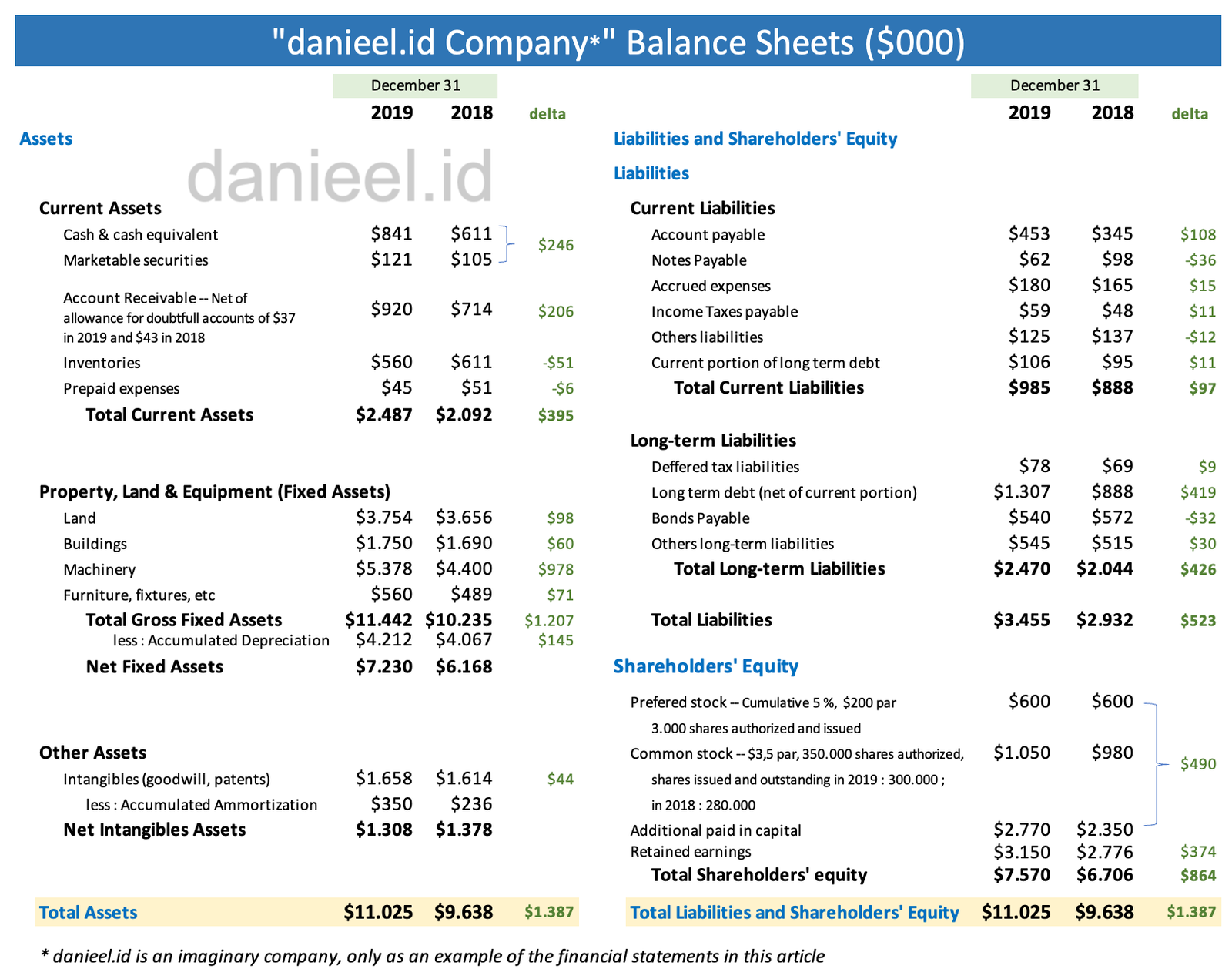
danieel.id Company’s total assets reached $11,025 thousand in 2019, up about 14.4% from the previous year. Gross fixed assets increased by $1,207 thousand, with the biggest increase coming from machinery worth $978 thousand. It’s a typical pattern for a manufacturer that is expanding its production capacity.
A quick review of the balance sheet
danieel.id Company’s accounts receivable rose about 28.9%, from $714 thousand to $920 thousand, far faster than sales, which grew about 12%. Receivables racing ahead on their own like this deserve a little suspicion (a polite one, of course).
Here’s the rough math: if receivables are divided by sales and multiplied by 365 days, sales were collected after about 55 days on average in 2019, up from about 48 days in 2018. Did credit sales increase, or did collections slow down? The balance sheet doesn’t say, but it shows us where to start asking.
On the financing side, total liabilities rose $523 thousand and equity rose about $864 thousand, with net long-term debt up $419 thousand. The current ratio stood at about 2.52 times in 2019, up from 2.36 times, while the debt-to-equity ratio was about 0.46 times. Keep in mind that ratios only become meaningful when compared with the company’s own history and its industry.
A line-by-line walkthrough is in How to Read a Company Balance Sheet Easily.
Statement of Changes in Equity: The Bridge for Owners’ Capital
The statement of changes in equity is the type of financial statement that bridges the owners’ capital balance at the start and end of a period, so we know exactly why equity went up or down. The changes can come from profit or loss for the period, dividends, new share issues, share buybacks, or other comprehensive income.
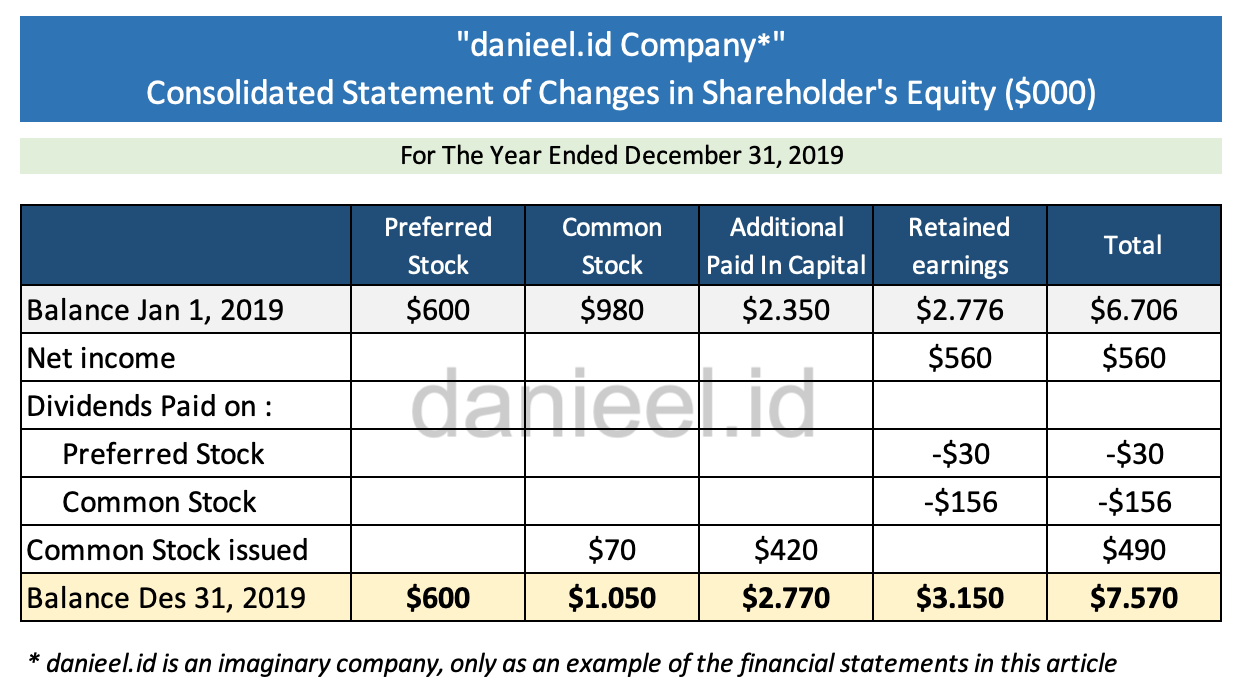
danieel.id Company’s equity moved from $6,706 thousand at the start of 2019 to $7,570 thousand at year-end. Net profit added $560 thousand, while preferred and common stock dividends reduced it by $30 thousand and $156 thousand respectively. The issue of new common shares added $70 thousand to common stock and $420 thousand to additional paid-in capital.
A quick review of changes in equity
danieel.id Company’s retained earnings rose from $2,776 thousand to $3,150 thousand, exactly net profit of $560 thousand minus total dividends of $186 thousand. This detail is often misunderstood: retained earnings are not a pile of cash in the bank, because they have very likely “changed form” into inventory, machinery, or receivables.
The share issue added $490 thousand in capital. Equity that grows from profit and equity that grows from fresh capital look the same on paper, but they mean very different things.
The full explanation is in How to Read a Statement of Changes in Equity, and the link between profit, assets, and equity can be explored further through DuPont Analysis for ROA and ROE.
Cash Flow Statement: Where the Cash Really Goes
The cash flow statement is the type of financial statement that explains the change in cash and cash equivalents over a period, grouped into operating, investing, and financing activities. This grouping follows IAS 7 Statement of Cash Flows, which Indonesia has adopted as PSAK 207 Statement of Cash Flows.
Why can profit and cash differ? Accounting uses the accrual basis: sales are recognized before customers pay, expenses are recognized before cash goes out, and depreciation reduces profit without any cash payment. That’s why net profit needs to be “translated” into cash through working capital adjustments and non-cash items. In a household, it’s like counting a salary as received when it won’t actually land until next week.
A quick review of the cash flow statement
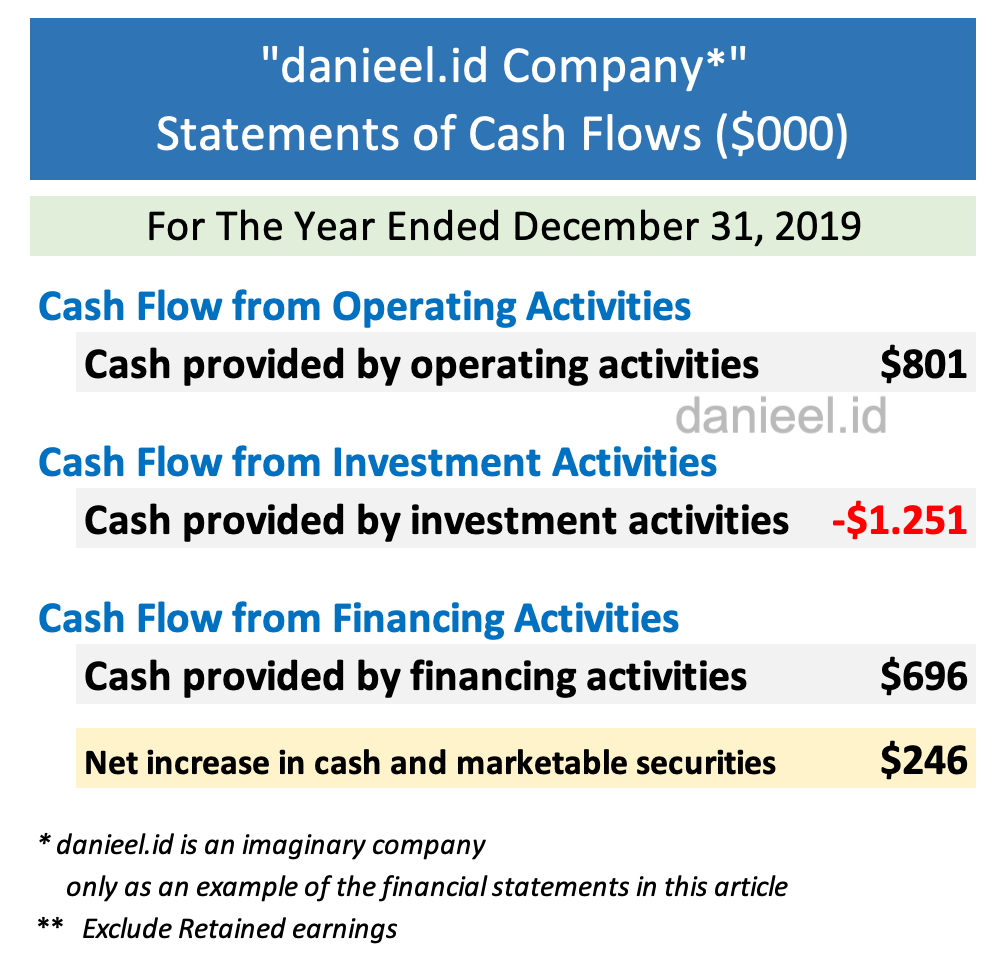
danieel.id Company’s operating activities generated positive cash of $801 thousand, more than its net profit of $560 thousand. Net profit is increased by adding back depreciation and amortization of $259 thousand, then adjusted for changes in working capital. The $206 thousand increase in receivables reduced operating cash, while the $108 thousand increase in accounts payable added to it.
danieel.id Company’s investing activities used $1,251 thousand in cash, mainly to add $1,207 thousand in gross fixed assets. An outflow that large isn’t automatically bad; the real question is whether the new machinery will eventually lift sales and profit enough.
Financing activities brought in $696 thousand from additional long-term debt and the share issue, after deducting debt repayments and dividends. Add the three together ($801 − $1,251 + $696) and cash and marketable securities rose by $246 thousand, exactly matching the change in the balance sheet from $716 thousand to $962 thousand. This small reconciliation proves that the four types of financial statements really do lock together.
The cash flow statement is covered line by line in How to Read a Company’s Cash Flow Statement.
This article covers stage 1 of the eight stages in our financial statement analysis guide. If you’d like to learn in order, from the basic statements all the way to stock valuation, start with its roadmap.
A Few Reader Questions About Financial Statements
What are the types of financial statements of a company?
A company’s main types of financial statements are four: the income statement, the balance sheet or statement of financial position, the statement of changes in equity, and the cash flow statement. Under PSAK 201, a complete set of financial statements also includes the notes to the financial statements.
Which type of financial statement should you read first?
Beginners should start with the income statement, because it is the easiest to understand and shows the results of operations for one period. After that, move on to the balance sheet to see the position of assets and debt, then check the cash flow statement to make sure profit actually turns into cash.
Why can a profitable company run short of cash?
A profitable company can run short of cash because profit is recorded on an accrual basis, while cash only comes in when customers actually pay. Piling receivables or a large machinery purchase can drain cash even when the income statement shows a profit.
Are retained earnings the same as a company’s cash?
A company’s retained earnings are not the same as its cash. Retained earnings are the accumulated profits not paid out as dividends, while the actual cash position is shown in the cash line on the balance sheet and in the cash flow statement.
Do small businesses (MSMEs) also have to prepare all four types of financial statements?
Indonesian micro, small, and medium enterprises (MSMEs) that use SAK EMKM do not have to prepare all four, because that standard simplifies financial statements into three components: the statement of financial position, the income statement, and the notes to the financial statements. Even so, tracking cash flow is still useful so that a small shop isn’t “profitable on paper but empty in the till”.
Conclusion: One Company, Four Points of View
In short, understanding the types of financial statements isn’t about memorizing definitions but about finding the links between the numbers. Are sales growing faster than costs, are assets financed in a healthy way, and most importantly, does profit actually turn into cash?
At danieel.id Company, the business is growing and operating cash flow stays positive. However, cost of goods sold rose faster than sales, receivables are taking longer to collect, and the machinery expansion required extra debt and new share capital. None of that is a verdict, just signals worth looking into.
Just like household finances, a big salary doesn’t mean much if installments pile up and the wallet is always empty by the 20th of the month. The same goes for companies: the four types of financial statements must be read together for the story to be complete. The first step is simple: take the annual report of a company you know, then compare its net profit growth with its operating cash flow.
After that, move on to calculating ratios and learning various stock valuation methods. The standards keep moving too: IAI has approved PSAK 118 Presentation and Disclosure in Financial Statements, which is based on IFRS 18 and replaces PSAK 201 for annual periods beginning on or after January 1, 2027. All four statements remain, but the income statement will include new subtotals such as operating profit.
A note from the author
This article is only an introduction, and the four statements are most useful when they are used to assess one company from start to finish. The full walkthrough will be in my upcoming e-book, Reading Financial Statements and Stock Valuation. If you prefer to practise straight away, there is also a companion Excel template, available separately.
Of the four types of financial statements above, which one do you usually skip when reading an annual report? Share your experience below; your way of reading them might help other readers who are just getting started.
Numbers never lie, but they only tell the whole truth when we’re willing to read all of them, not just the pleasant ones.
This post is also available in: