







If a company earned a net income of only $560 thousand in a year, how did its equity grow by $864 thousand? Even more puzzling, its retained earnings rose by just $374 thousand. So where did the extra come from, and where did the rest of the profit go?
The answer sits in one report that most people skip right past: the statement of changes in equity. Learning how to read a statement of changes in equity is really about following the owners’ capital from its opening balance to its closing balance, noting what increased it, what reduced it, and where each change came from.
A statement of changes in equity is a report that reconciles the balance of each component of owners’ equity, such as share capital, additional paid-in capital, and retained earnings, between the start and the end of a period. It acts as the bridge between the income statement and the balance sheet: net income flows into retained earnings, dividends reduce it, and share issuances or buybacks change paid-in capital. The closing balances then appear in the equity section of the balance sheet.
Think of this report as a savings passbook. There is an opening balance, there are deposits, there are withdrawals, and there is a closing balance. The difference is that a company’s “deposits” can come through two doors: its own business results (profit) or fresh money from shareholders. Telling those two doors apart is the heart of the analysis.
This report is not just an add-on, either. Under IAS 1 on the presentation of financial statements, this statement is part of a complete set of financial statements. That requirement stays in place as IFRS 18 supersedes IAS 1 for annual periods beginning on or after 1 January 2027. In Indonesia, the same list of financial statement components appears in PSAK 201, the local accounting standard.
To keep this from staying theoretical, let’s follow one example from start to finish: the imaginary danieel.id/ Company in 2019, with every figure in thousands of US dollars ($000). The framework of the example follows Principles of Managerial Finance, 13th edition, by Lawrence J. Gitman and Chad J. Zutter. There are five steps, and each one leads into the next.
How to Read a Statement of Changes in Equity: Start with the Opening Balance
The first step is to note the opening balance of each equity component, because the opening balance is the benchmark for judging every change that happens during the year.
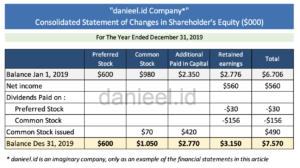
As of 1 January 2019, danieel.id/ Company had preferred stock of $600, common stock of $980, additional paid-in capital of $2,350 (in Indonesia, the share premium portion is known as agio saham), and retained earnings of $2,776. Total opening equity was $6,706.
The biggest temptation is to jump straight to the total on the bottom line (the same habit as opening a school report card and hunting for the class ranking first). Yet with the opening balance of each component in hand, we can separate changes that come from business performance from changes that come from transactions with owners. Those two kinds of change tell very different stories.
Trace Net Income and Dividends
Net income increases retained earnings, while dividends paid to shareholders reduce it, so the difference between the two shows how much of the profit actually stays inside the company.
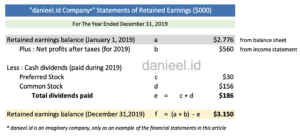
During 2019, danieel.id/ Company recorded net income after tax of $560. The company also paid preferred stock dividends of $30 and common stock dividends of $156, for total dividends of $186. The reconciliation is simple:
Ending retained earnings = beginning retained earnings + net income – dividends
$2,776 + $560 – $186 = $3,150
Here is the first answer to the puzzle at the top of this article. The $560 profit did not all stay put; after dividends, only $374 was left to add to retained earnings. As a rough picture, the dividend payout ratio was about 33% ($186 ÷ $560). In other words, out of every $100 of profit, about $33 went to shareholders and $67 was kept to support growth.
One more thing: higher profit does not mean cash grew by the same amount. The income statement is prepared on an accrual basis, so actual cash movements need to be checked in the cash flow statement. That is also where dividend payments show up as a cash outflow from financing activities.
Read the Share Issuance and Additional Capital
Issuing new shares increases equity through two accounts at once: common stock at the shares’ par value, and additional paid-in capital for the amount of the selling price above that par value.
In this example, common stock rose by $70, while additional paid-in capital rose by $420. Total proceeds from the new shares came to $490. Wait, why did common stock go up by only $70 and not $490? Because common stock is usually recorded at its nominal or par value. Whatever part of the issue price exceeds par value goes into additional paid-in capital.
Still confusing? Let’s work it out per share. According to danieel.id Company’s balance sheet, the number of common shares rose from 280,000 to 300,000, which means 20,000 new shares were issued. Proceeds of $490 thousand divided by 20,000 shares gives a selling price of about $24.50 per share. Of that, $3.50 is par value ($70 thousand ÷ 20,000), and the remaining $21 is the share premium. So anyone who glances only at the common stock account would think far less money came in than actually did.
After the issuance, preferred stock stayed at $600, common stock moved from $980 to $1,050, and additional paid-in capital moved from $2,350 to $2,770. In the financial statements of Indonesian listed companies, these two accounts usually appear as “issued and fully paid share capital” and “additional paid-in capital”.
Worth noting: the danieel.id/ Company example is deliberately simple. A real company’s equity statement often includes other components, such as treasury shares (shares bought back, which reduce equity), other comprehensive income, or non-controlling interests. The pattern stays the same: opening balance, movements during the period, then closing balance.
Understand Retained Earnings Correctly
Retained earnings are a company’s accumulated profits that have not yet been distributed to shareholders, not cash sitting in one special bank account.
This misunderstanding comes up quite often. Retained earnings of $3,150 do not mean there is $3,150 thousand lying idle in the bank. That money may already have been used to buy inventory, machinery, or buildings, or to fund customer receivables.
Using the savings passbook analogy, retained earnings are more like a record of total deposits from your own work than the contents of your wallet today. The money may already have been “spent” on other assets. That is why retained earnings should be read together with the balance sheet and the cash flow statement: the balance tells us how much of equity came from accumulated profit, but not where the money is now. How all four financial statements connect is covered more fully in the discussion of the four types of company financial statements.
Analyze Where Equity Growth Comes From
The final step is to break down equity growth by its source, namely retained profit and new capital contributions, because the two tell different stories about the company’s condition.
The movement of each equity component at danieel.id/ Company during 2019 is summarized in the table below (in $000).
| Equity component | Start → end of 2019 | Reason for change |
|---|---|---|
| Preferred stock | $600 → $600 | No change |
| Common stock | $980 → $1,050 | New shares at par value (+$70) |
| Additional paid-in capital | $2,350 → $2,770 | Premium on new shares (+$420) |
| Retained earnings | $2,776 → $3,150 | Profit $560 minus dividends $186 |
| Total equity | $6,706 → $7,570 | Up $864 |
The table shows that the $864 increase in equity came from two sources: $374 of retained profit (about 43%) and $490 of new capital (about 57%). So more than half of that year’s equity growth actually came from new shareholders, not from business results. That is the last piece of the puzzle from the opening.
Once the basic numbers are clear, the analysis continues with asking the right questions:
- Does equity growth come mainly from profit or from issuing new shares?
- How much of the profit is paid out as dividends, and how much is retained for growth?
- Has the number of shares increased, diluting existing shareholders’ ownership?
- Are retained earnings rising consistently from year to year?
- Does the closing balance of each component match the equity figures on the balance sheet?
Dilution can be made concrete with a quick calculation. A shareholder who owned 28,000 shares (10% of 280,000) and did not buy any of the new shares now owns only about 9.3% of 300,000. Their stake shrinks even though they did not lose a single share.
This kind of interpretation matters, but it should stay fair. A company whose equity grows through accumulated profit has a different story from one that relies on issuing shares, and neither is automatically good or bad. Issuing shares to build a profitable factory may be a smart decision; issuing shares to patch up recurring losses is another story. We still need to look at the purpose of the funding, the business outlook, and the impact on shareholders, for example through company financial ratios such as ROE and earnings per share.
A Few Questions from Readers
What is the purpose of a statement of changes in equity?
This statement explains why owners’ capital changed during a period, from net income and dividends to share issuances and share buybacks. Without it, we would only see equity go up or down on the balance sheet without knowing why.
How is a statement of changes in equity different from a balance sheet?
A balance sheet shows assets, liabilities, and equity at a single point in time, while a statement of changes in equity explains how equity moved over a whole period. Think of a photo versus a video: the balance sheet snaps the closing balance, and the equity statement records the journey to it.
Why aren’t dividends recorded in the income statement?
Dividends are not recorded in the income statement because they are a distribution of profit to owners, not an expense of running the business. That is why dividends directly reduce retained earnings in the equity statement, like the $186 deduction at danieel.id/ Company.
How do I read the statement of changes in equity of a company listed on the Indonesia Stock Exchange?
You read it the same way as the example above: start from the opening balance, trace profit and dividends, check any share issuances or buybacks, then match the closing balances with the balance sheet. The reports can be downloaded for free from the Indonesia Stock Exchange website under Listed Companies, then Financial Statements and Annual Reports. The statement is usually titled “consolidated statement of changes in equity”.
Conclusion: Follow the Trail of Capital, Not Just the Total
In short, how to read a statement of changes in equity comes down to following the reconciliation from opening capital to closing capital. Profit adds to retained earnings, dividends reduce it, and share issuances add to paid-in capital. In the danieel.id/ Company example, equity rose from $6,706 to $7,570, yet only about 43% of that increase came from business results.
Back to that savings passbook: a growing balance does not necessarily mean we have been working harder; someone else may have sent money in. So use this report as a connector, not a stand-alone document. Match net income with the income statement, closing balances with the balance sheet, and dividends and share issuances with financing cash flows.
The first step is simple: open the annual report of a listed company you know, then work out what percentage of its equity growth came from retained earnings. The result is often more honest than a headline saying “company equity soars”.
Which do you find more convincing: a company whose equity grows slowly through retained earnings, or one that grows fast by issuing new shares to expand? I’m curious to read your answer in the comments.
The number on the bottom line matters, but the story is always in the lines above it.
Read also:
4 Types of Financial Statements and How to Read Them Easily
This post is also available in: