







If you were given a long life, how would you want to spend your 90s? Still weeding your own garden, joking with your grandchildren, then walking to the market and greeting the neighbors along the way? It sounds like a scene from a milk commercial for seniors. Yet in a few corners of the world, that picture is nothing out of the ordinary.
That is what makes the Blue Zones worth exploring. Blue Zones are regions or communities with a remarkably high share of people aged 100 and over (centenarians), many of whom stay active well into old age. The goal is not to find a formula for reaching 100, but to learn how to look after our quality of life as the years add up.
The five regions most often discussed are Ogliastra in Sardinia (Italy), Okinawa (Japan), the Nicoya Peninsula (Costa Rica), Ikaria (Greece), and the Adventist community of Loma Linda (California, United States). Their cultures, languages, and religions differ, yet their ways of life are strikingly similar.

The easiest way to understand it: the habits of these centenarians are like dropping coins into a bamboo piggy bank. Each deposit is small and barely noticeable: walking to the garden, eating just enough, dropping by a neighbor’s house. But after decades, the total is surprising.
The eight lessons below are connected: seven about everyday habits, plus one about what makes each region unique. Let’s start with the one closest to the kitchen.
Prefer to watch instead? I also cover these eight Blue Zone lessons in a video with narration and illustrations. Watch it on YouTube, then share which healthy habit you would like to start. If you prefer reading, just continue below the video player.
Natural Food: The First Lesson from the Blue Zones
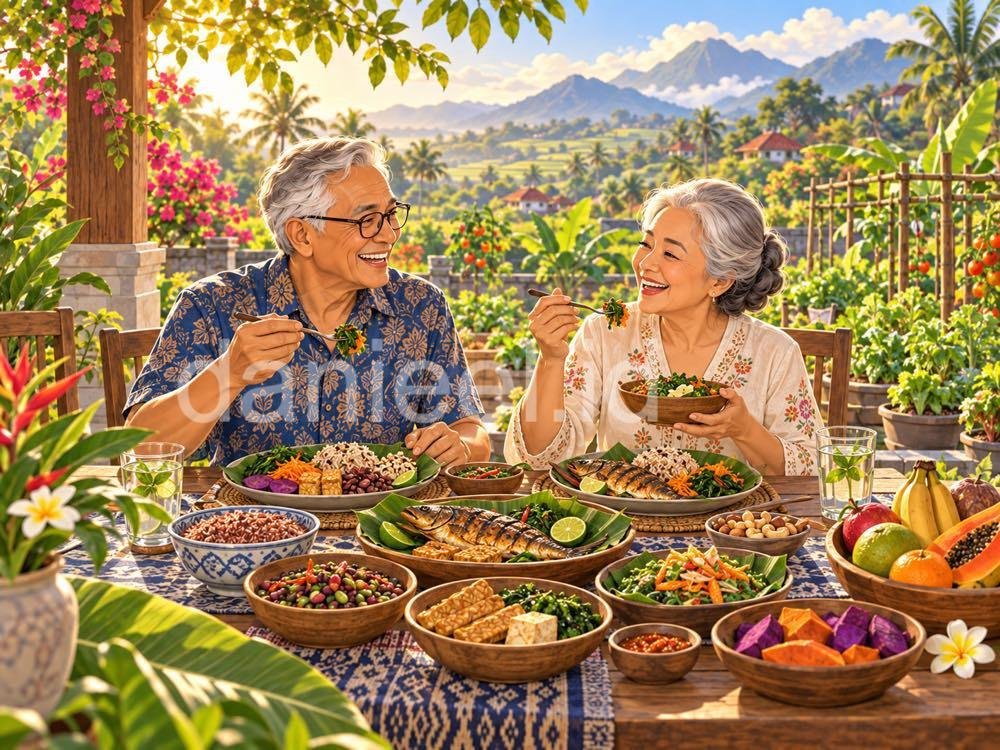
The first lesson from the Blue Zones is to eat real, minimally processed food that comes mostly from plants and is often home-grown. Meat still appears, but usually as a supporting actor.
In a clinical trial by Hall et al. (2019) in Cell Metabolism, 20 adults followed an ultra-processed diet and an unprocessed diet for two weeks each. On the ultra-processed diet, they ate about 508 kcal more per day, roughly two extra plates of rice, and gained an average of 0.9 kg. And they were free to eat as much as they wanted. This short trial looked at energy intake and body weight; it is not proof that any particular menu guarantees a long life.
In Okinawa, the traditional staple was not rice but sweet potato, served alongside tofu, miso, seaweed, and bitter melon. The good news is that the Indonesian kitchen has its own equivalents: sweet potatoes, tempeh, tofu, grilled fish or pepes (fish steamed in banana leaves), sayur bening (a light clear vegetable soup), and lalapan (fresh raw vegetables). For more variety on your menu, 10 easy superfoods you can keep at home makes good further reading.
Stop Eating Before You Are Full

Okinawans practice hara hachi bu, the habit of stopping when the stomach feels about 80 percent full. It is not an invitation to count every grain of rice, but a pause before fullness turns into that heavy, bloated feeling.
A review by Willcox et al. (2007) in the Annals of the New York Academy of Sciences of long-term data on older Okinawans showed relatively low calorie intake, a low lifelong BMI, and a low risk of age-related diseases. Those benefits were, of course, also supported by traditional foods that are nutrient-dense yet hard to overeat.
The 80 percent figure is not a precise measurement (our stomachs do not come with a battery indicator like our phones). For older adults, eating moderately must still meet their energy and protein needs.
The Prophet Muhammad (peace be upon him) taught that a few morsels are enough for the son of Adam to keep his back upright. If he must eat more, then one third for food, one third for drink, and one third for breath (paraphrased from Jami’ at-Tirmidhi no. 2380).
Of course, this hadith is not a diet plan with numbers, but a reminder that knowing when enough is enough is part of good table manners.
Move Naturally Every Day, Not Just at the Gym

Blue Zone residents stay active not because they are gym regulars, but because their bodies move naturally all day long: walking up slopes, tending gardens, cooking, and doing their own housework.
In Ikaria, a study by Legrand et al. (2021) of residents aged 90 and over found that most of them were still physically active, mainly from farming and walking.
A pooled analysis by Arem et al. (2015) in JAMA Internal Medicine of more than 660,000 people found that about 150–300 minutes of brisk walking per week was associated with a 31 percent lower risk of death. As a rough picture, 150 minutes a week is only about 20 minutes a day, less than 2 percent of our week.
The lesson is simple: regular exercise still needs to go hand in hand with sitting less (sitting all day at work, then lying on the couch scrolling through our phones at home, haha). Walking to the corner shop, taking the stairs, and sweeping the yard really do count. A good time to start is right after a meal; see the benefits of walking after a meal.
Have a Reason to Get Up in the Morning

People who feel they have no purpose in life tend to face a higher risk of death, and Blue Zone residents have their own words for that purpose: ikigai in Okinawa and plan de vida in Nicoya.
It does not have to be grand. Tending a garden, taking a grandchild to school, helping a neighbor, or teaching children to read the Qur’an is enough to give life direction. Their days still come with “jobs” to do.
The Ohsaki Study (Sone et al., 2008) in Psychosomatic Medicine followed more than 43,000 Japanese adults for seven years. Those who did not feel they had ikigai faced an all-cause mortality risk about 1.5 times higher. This observational study does not prove that purpose works like medicine, but it makes sense that people who feel their lives are meaningful are more motivated to take care of themselves.
In Islam, this spirit echoes the saying of the Prophet Muhammad (peace be upon him): “The best of people are those who are most beneficial to others” (translated excerpt, narrated by At-Tabarani). In other words, we are not only trying to add years to our life, but also to add life to those years.
Keep Family and Friends Close

Close social ties are among the Blue Zones habits with the strongest scientific support, as multigenerational families live close together and older people stay involved in daily life. Okinawa has the moai, a group of lifelong friends who support one another, while in Ikaria most of the people aged 90 and over who were studied had social contact every day.
A meta-analysis by Holt-Lunstad et al. (2010) in PLoS Medicine, combining 148 studies with more than 300,000 participants, found that stronger social relationships were associated with better survival, with a pooled odds ratio of about 1.5. This does not mean life is 50 percent longer; it means that, over the study periods, people with strong social ties were more likely to still be alive.
The catch is that we sometimes diligently count calories and daily steps, yet forget to schedule time to visit family and friends (I am guilty of it too).
“Whoever loves that he be granted more wealth and that his lease of life be prolonged, then he should keep good relations with his kith and kin” (Sahih al-Bukhari no. 5986).
Of course, our lifespan is in God’s hands, but keeping ties of kinship is clearly a worthwhile effort.
Belong to a Faith Community

An often-overlooked part of life in the Blue Zones is the faith community, which provides a worship schedule, regular gatherings, and social support. The Adventists of Loma Linda keep a weekly Sabbath, while many older Ikarians take an active part in religious activities and village festivals.
A study by Li et al. (2016) in JAMA Internal Medicine, which followed more than 74,000 female nurses in the United States, found that those who attended religious services more than once a week had about a 33 percent lower risk of death than those who never attended. Remember, this is a statistical association, not a promise that worship works as medicine.
In Indonesia, this takes very familiar forms: congregational prayers at the mosque, majelis taklim (religious study circles), or regular pengajian (Qur’an study gatherings) in the neighborhood.
Slow Down: Afternoon Naps and Relaxing Rituals

Slowing down is also part of life in the Blue Zones, because residents have daily rituals for easing stress: Ikarians are used to afternoon naps, Okinawans set aside time to remember their ancestors, and Adventists stop working on the Sabbath.
Research by Naska et al. (2007) in the Archives of Internal Medicine of more than 23,000 Greek adults found that taking afternoon naps was associated with about 37 percent lower coronary heart disease mortality, especially among working men. The findings are observational, and naps need not be forced if they end up disrupting nighttime sleep.
Stress can never be removed from life; what makes the difference is whether we have rituals for returning to calm. Prayer, remembrance of God (dhikr), a leisurely walk, or tea with family can all act as a “pause” button. So the ability to slow down is not laziness, but a form of self-care.
Different Blue Zones, Different Ways of Life
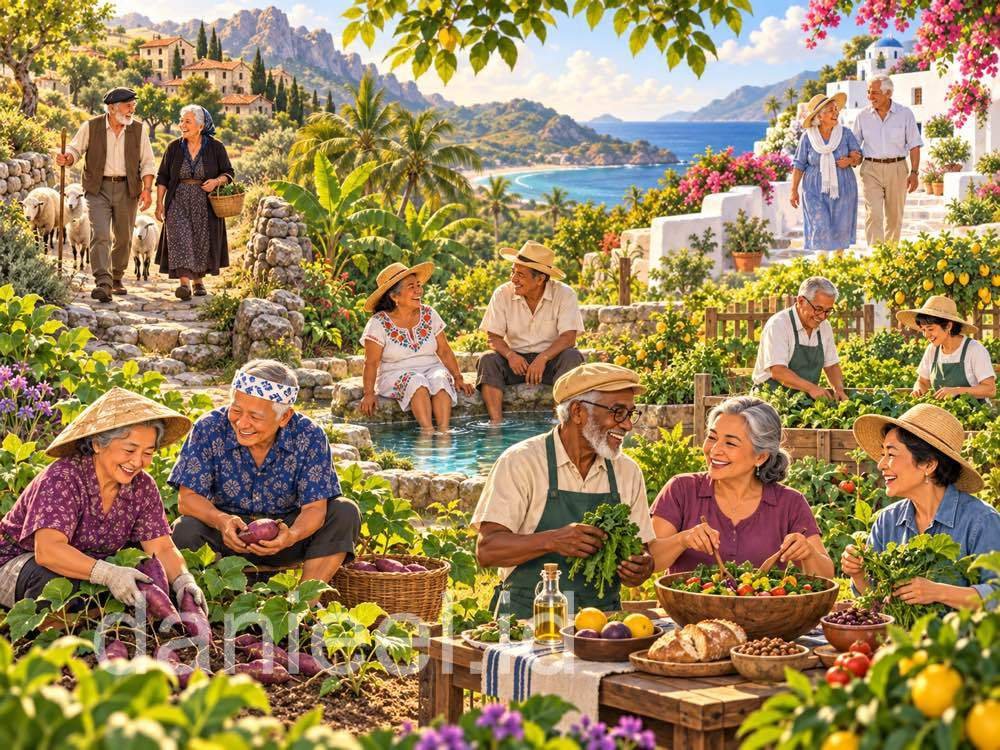
Each of the Blue Zones has its own distinctive habits, so the eighth lesson is to copy the principles, not the menu or the location.
To make them easier to compare, here is a summary of the five regions:
| Region | Distinctive habits | Lesson for us |
|---|---|---|
| Sardinia (Italy) | Villages on steep slopes, a shepherding tradition | Move naturally every day |
| Okinawa (Japan) | Hara hachi bu, ikigai, moai | Eat moderately, have a purpose |
| Nicoya (Costa Rica) | Plan de vida, strong family bonds | Stay close to family |
| Ikaria (Greece) | Mediterranean diet, afternoon naps | Make time to slow down |
| Loma Linda (US) | Plant-based diet, weekly Sabbath | Nurture a faith community |
The table shows that there is no one-size-fits-all program. We do not need to move to a Greek island; the principles already feel familiar to us in Indonesia: walking to the mosque, gotong royong (neighborly mutual help), family meals, backyard gardening, and visiting relatives during Eid. The challenge is keeping all of that from being crowded out by chairs, packaged snacks, and screens.
How to Apply the Blue Zones Lessons at Home
The Blue Zones lessons can be applied at home without overhauling your whole life overnight, simply through light habits repeated every day:
- Fill half your plate with vegetables and choose foods whose original form is still easy to recognize.
- Eat more slowly, and stop before your stomach feels full.
- Walk for 10–15 minutes after meals as you are able.
- Write down one simple reason why you want to get up tomorrow morning.
- Call family or friends without waiting for a reason.
For a broader routine, you can also read 18 tips for a healthy and fit life.
A Few Questions from Readers
What are the Blue Zones?
The Blue Zones are regions with a high proportion of people aged 100 and over, most notably Sardinia, Okinawa, Nicoya, Ikaria, and Loma Linda. The term began with demographer Michel Poulain and physician Gianni Pes, who marked long-lived villages on a map of Sardinia with blue ink; it was later popularized by journalist Dan Buettner.
What is the most important secret of the Blue Zones?
There is no single secret; the most consistent pattern is a combination of small habits: natural food, moderate portions, movement throughout the day, a sense of purpose, social connection, a faith community, and time to slow down. Their power lies in years of repetition, not in one “miracle” food.
Can Blue Zones data be trusted?
Partly, with caveats. The ages of residents in early regions such as Sardinia were validated by demographers using birth documents and civil records, as summarized by Poulain et al. (2013). However, an analysis by Luis Rosero-Bixby (2023) in Demographic Research found that Nicoya’s advantage is fading: men born in 1905 had adult mortality about 33 percent lower than the Costa Rican average, while those born in 1945 had rates about 10 percent higher. A preprint by Saul Newman on bioRxiv also questions the accuracy of many extreme-age records worldwide.
Does a Blue Zones lifestyle guarantee a long life?
No. Most research on Blue Zones habits is observational, so it shows associations rather than always proving cause and effect; genetics, environment, and healthcare also play a role. These habits are still a sensible inspiration for aging more healthily.
Can the Blue Zones lessons be applied in Indonesia?
Yes, because the principles are simple and many local equivalents already exist. Sweet potatoes, tempeh, sayur bening, walking to the mosque, pengajian, and visiting relatives are local versions of the same habits.
Closing: A Habit Piggy Bank, Filled Little by Little
Back to the picture we started with: older people who still weed their gardens and walk to the market did not get there through one big decision. The real secret of the Blue Zones lies in food that stays close to the garden, moderate portions, a body that keeps moving, a sense of purpose, and the people closest to us. A bamboo piggy bank, too, does not fill up with one big deposit, but with steady, continuous ones. The first step is simple: swap some packaged snacks for sweet potatoes or fruit, take a walk after dinner, and call your parents or an old friend this week.
Our lifespan remains in God’s hands, and no lifestyle can promise us 100 years. But we can choose how to live the years we are given: with a more active body, warmer relationships, and a life that feels useful.
Of these eight lessons, the one I most need to work on myself is sitting too long. How about you: which small deposit would you most like to start this week? Share your experience below; it might encourage other readers.
May God grant us a blessed life, a healthy body, and a heart that always stays close to the people we love. Amen.
Note: this article is for general education and is not a substitute for advice from a doctor or other qualified healthcare professional.
References
- Buettner D, Skemp S. (2016). Blue Zones: Lessons From the World’s Longest Lived. American Journal of Lifestyle Medicine, 10(5), 318–321. https://doi.org/10.1177/1559827616637066
- Poulain M, Herm A, Pes G. (2013). The Blue Zones: Areas of Exceptional Longevity Around the World. Vienna Yearbook of Population Research, 11, 87–108. https://doi.org/10.1553/populationyearbook2013s87
- Holt-Lunstad J, Smith TB, Layton JB. (2010). Social Relationships and Mortality Risk: A Meta-Analytic Review. PLoS Medicine, 7(7), e1000316. https://doi.org/10.1371/journal.pmed.1000316
This post is also available in: