







Some films we know by heart, yet every time we rewatch them, we still end up misty-eyed. Strange, isn’t it? What moves us turns out not to be the surprise, but storytelling that is just right. That is why the story of Prophet Yusuf (Joseph) holds such a special place. Allah Himself calls it ahsanal qashash, the best of stories, at the very beginning of the surah that contains it:
“We relate to you, [O Muhammad], the best of stories in what We have revealed to you of this Qur’an although you were, before it, among the unaware.” (QS. Yusuf: 3)
In short, the story of Prophet Yusuf is called the best of stories because both its content and its telling are exceptional: it is complete within a single surah, arranged as neatly as a mirror image, rich in life lessons, and it ends in forgiveness rather than revenge.
Imagine a piece of songket from Palembang, the traditional Indonesian fabric woven with gold thread. From a distance, all you see is a cloth shimmering with gold. Step closer, and you notice that the motifs on the left and right mirror each other, without a single thread woven carelessly. Surah Yusuf is the same: the closer you read it, the more its craftsmanship shows.
You can also watch the story of Prophet Yusuf in the video below, or keep reading.
To be fair, it’s worth saying up front that scholars don’t all agree on what “best” means in that verse. Some understand it as referring specifically to the story of Yusuf, while others take it as describing the way the Qur’an tells stories in general. From these two readings come ten reasons put forward by classical scholars and contemporary thinkers alike. Let’s start with the wording of the verse itself.
Told Directly by Allah in the Best Way

The first thing that makes the story of Prophet Yusuf special lies in the words themselves: the phrase ahsanal qashash can mean “the best way of narrating”, not merely “the best story”, and the narrator is Allah. The word qashash comes from the root qashsha, which means to follow someone’s footsteps, step by step. That’s why a number of exegetes read it as a masdar (a verbal noun): what is being praised is also the way the story is told.
Nouman Ali Khan, an American Muslim speaker and founder of Bayyinah Institute, sums up three possible meanings of this phrase: the best story among all stories, the best way to tell a story, and the best part of the story, namely the part richest in guidance. He also highlights the emphasis on “We relate”.
Ibn Kathir, in his tafsir as published on daaralatsarindonesia.com (in Indonesian), records a lovely reflection on this verse. When the Companions wanted a story, Allah pointed them to the best of stories. When they wanted narratives, Allah pointed them to the best of narratives. Shaykh Abdurrahman as-Sa’di, a 14th-century AH exegete, adds that the story is called the best in terms of its truthfulness, its smoothly flowing narration, and the beauty of its meanings (in Indonesian). Interestingly, the story of Yusuf was already known to the People of the Book before the Qur’an was revealed, so what makes it special isn’t “breaking news”, but the way it is told.
The Only Prophet’s Story Told in Full Within a Single Surah

The story of Prophet Yusuf is the only prophet’s story in the Qur’an told in order from beginning to end within a single surah: Surah Yusuf, which consists of 111 verses. Compare it with the story of Prophet Musa (Moses). Its pieces are scattered across many surahs, and each piece highlights a different side.
Shaykh Abu Bakr Jabir al-Jazairi, a teacher of tafsir at the Prophet’s Mosque in Madinah, explains in Aisar at-Tafasir that “We relate” means narrating a story exactly as it happened, in full (in Indonesian). According to reports attributed to Ibn Abbas and Qatadah, this surah was even revealed all at once, except for a few verses. The narration is economical, too: according to Nouman Ali Khan, roughly a decade of Yusuf’s life is summed up in just four verses, because details that carry no guidance are left out.
The story spans about 40 years, yet you can read its translation in a single sitting, with none of the “filler scenes” of a soap opera.
The Mirror-Like Symmetry of the Story of Prophet Yusuf

The story of Prophet Yusuf is arranged symmetrically: the beginning and end of the surah answer each other, then the structure moves inward toward a single center point. This is where the songket analogy comes into its own. In his lecture “S. Yusuf: The Incredible Symmetry of the Story”, Nouman Ali Khan invites listeners to see Surah Yusuf not as a story running in a straight line, but as an arrangement that mirrors itself. He builds on the study by Jawad Anwar Qureshi, “Ring Composition in Sūrat Yūsuf (Q 12)”, published in the Journal of the International Qur’anic Studies Association (2017). An early version of this study even won the association’s first Andrew Rippin Best Paper Prize.
Ring composition (a circular or ring-shaped arrangement) is the term textual scholars use for a narrative pattern that moves forward to a center point, then “turns around” and revisits earlier themes in reverse order: A, B, C, then the center, followed by C’, B’, A’. British anthropologist Mary Douglas, in her book Thinking in Circles (Yale University Press, 2007), explains that this technique places the main meaning in the middle, framed by a beginning and an ending that run parallel.
Still confused? Picture climbing a staircase to the top floor, then coming back down the very same steps.
The Outer Ring: From Dream to Dream
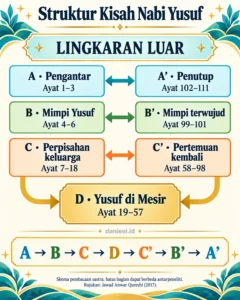
The outer ring of Surah Yusuf is made up of seven symmetrical blocks:
- A (verses 1–3): an introduction addressed to Prophet Muhammad SAW about “the best of stories”, mirrored by A’ (verses 102–111), a conclusion that addresses him once again.
- B (verses 4–6): young Yusuf tells his father about his dream, mirrored by B’ (verses 99–101), when that dream comes true, again in a conversation between father and son.
- C (verses 7–18): the family drama of Ya’qub (Jacob) that ends in separation, mirrored by C’ (verses 58–98), the same family drama, this time ending in reunion.
- D (verses 19–57): the center of the ring, namely Yusuf’s life in Egypt.
These pairs are locked together by the same words. In block B, Yusuf says, “O my father, indeed I have seen [in a dream] eleven stars and the sun and the moon; I saw them prostrating to me” (QS. Yusuf: 4). In block B’, he addresses him again: “O my father, this is the explanation of my vision of before” (QS. Yusuf: 100). Prophet Ya’qub’s words, “So patience is most fitting”, are spoken twice: in verse 18 and verse 83.

Even Yusuf’s shirt becomes a marker. The shirt stained with false blood is evidence of a lie (verse 18), while the shirt Yusuf sends to Canaan becomes good news that restores Ya’qub’s sight (verses 93 and 96). In between, the shirt torn from behind becomes proof of Yusuf’s honesty (verses 25–28). One object, three roles, and even their positions are symmetrical.
The Inner Ring: Yusuf in Egypt
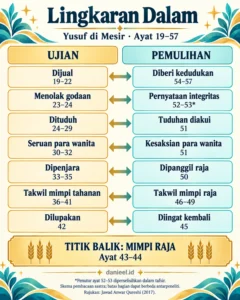
According to Qureshi, the central block of Surah Yusuf (verses 19–57) is itself arranged as a separate ring, a ring within a ring. The wonder doesn’t stop there, because every step down is paired with a step up:
| First half: going down | Second half: going up |
|---|---|
| Sold as a slave, of low status (19–22) | Appointed over the storehouses of the land (54–57) |
| Resists temptation out of loyalty to his master (23–24) | His loyalty to his master is acknowledged (52–53) |
| The wife of Egypt’s official accuses him; the torn shirt (24–29) | The wife of Egypt’s official admits Yusuf is innocent (51) |
| The women cut their hands and exclaim “Perfect is Allah!” (30–32) | The women testify to Yusuf’s purity with the same exclamation (51) |
| Yusuf is imprisoned (33–35) | Yusuf is released (50) |
| Interprets the dreams of two fellow prisoners (36–41) | Interprets the king’s dream (46–49) |
| The freed companion forgets Yusuf (42) | That companion finally remembers Yusuf (45) |
| Center point: the king’s dream (43–44) | |
Every step down is paid back in full by a step up, in reverse order, passing over the same “stairs”. This block is also framed by the same sentence: “And thus, We established Joseph in the land”, which appears in verse 21 and is repeated almost word for word in verse 56.
Why Is the King’s Dream at the Center?

The king’s dream (verses 43–44) sits at the center because from that moment on, Yusuf’s whole situation begins to turn around. As Mary Douglas puts it, the center becomes the hinge of the story: a forgotten prisoner is suddenly summoned by the palace.
The turning point in Yusuf’s life didn’t come from his own lobbying, but from a dream that Allah placed in a king’s sleep, in line with the common thread of this surah: “And Allah is predominant over His affair, but most of the people do not know” (QS. Yusuf: 21).
Qureshi also notes a smaller ring in verses 35–42, centered on Yusuf’s call to his two fellow prisoners: “O [my] two companions of prison, are separate lords better or Allah, the One, the Prevailing?” (QS. Yusuf: 39). Right near the heart of this story, what echoes is tawhid, the oneness of God.
Long before that, Mustansir Mir, in his article “The Qur’anic Story of Joseph: Plot, Themes, and Characters” (The Muslim World, 1986), had already observed a similar pattern: tension is built up in the first half, then resolved in reverse order.
It’s worth noting that dividing the structure this way is the result of human study of the text, not part of the revelation itself, and scholars sometimes differ on where each section begins and ends. Yet when many scholars from different backgrounds find similar patterns, in a surah revealed orally to a Prophet who could neither read nor write, we have good reason to pause and be amazed. Subhanallah.
The Richest in Lessons and Characters

Classical scholars considered the story of Prophet Yusuf to contain the most lessons and wisdom of all the stories in the Qur’an, with a remarkably crowded stage of characters. Al-Tha’labi, in al-Kashf wa al-Bayan, as summarized by tafsiralquran.id (in Indonesian), states that no other story in the Qur’an contains as many lessons as this one. In it there are prophets, righteous people, angels, devils, a king, slaves, merchants, and scholars. Its themes range from tawhid and dream interpretation to trade and politics.
Al-Baghawi adds that the story is full of wisdom and gentle words that gladden the heart, beneficial for both religion and worldly life. Its time span is long, too: according to Ibn Abbas and the majority of scholars, about 40 years passed from Yusuf’s dream to the family reunion.
This means almost every role in our lives has a mirror here: the jealous older brother, the father holding back his longing, the young man being tempted, the employee falsely accused, all the way to the official managing a food crisis. Sibling jealousy born of feeling that “Dad loves him more” (verse 8) also sounds familiar in many homes, perhaps even our own.
A Comfort for the Prophet in His Hardest Times

The story of Prophet Yusuf was revealed in Makkah during an extremely difficult period for Prophet Muhammad SAW, so it served to comfort and strengthen his heart. According to a number of scholars, this surah was revealed after ‘Am al-Huzn (the Year of Sorrow). At that time, he had lost Khadijah and Abu Talib, and was then harshly rejected by the people of Ta’if.
There is also a report from Sa’d ibn Abi Waqqas, recorded by Ibn Jarir at-Tabari and al-Hakim (who graded its chain authentic): the Companions felt weary and asked the Messenger of Allah to tell them stories, and so the opening of Surah Yusuf was revealed. Both reports describe hearts that were tired and in need of strength.
Then Allah brought the story of a prophet who was betrayed by his family, driven from his homeland, slandered, imprisoned, yet ultimately honored. Its message seemed to say: “Your path will be like this, too.” Not long afterward, the Prophet migrated to Madinah, and later returned to Makkah victorious. The stories of the prophets are not bedtime fairy tales, but mirrors of history full of ibrah (lessons), as we also reflected on in the lessons from the rise and fall of world civilizations.
Revealing Allah’s Subtle Plan Behind Hardship

The story of Prophet Yusuf shows that a string of seemingly endless misfortunes can turn out to be the steps of a very subtle plan from Allah. Yusuf himself sums it up near the end of the story in a single sentence:
“Indeed, my Lord is Subtle in what He wills. Indeed, it is He who is the Knowing, the Wise.” (QS. Yusuf: 100)
The word lathif in this verse is explained in Tafsir Al-Muyassar, as translated on daaralatsarindonesia.com (in Indonesian), as Allah being subtle in His planning. Try tracing the chain. Had he not been thrown into the well, Yusuf would not have been taken by a caravan to Egypt. Without the slander, he would not have been imprisoned and would not have met the king’s cupbearer. Had the cupbearer not forgotten him, Yusuf might have been freed sooner, but he would not have been in the right place when the king had his dream. Without the famine, his brothers would never have come to Egypt to buy grain.
Each link in the chain feels bitter while we live through it, but looks orderly from the end of the story. It’s like looking at songket from the back: all you see are tangled knots of thread, and the beautiful motif only appears when the cloth is turned over. In other words, we often see only the back side of the fabric of our own lives.
A Model of Guarding One’s Honor When No One Is Watching

In the story of Prophet Yusuf, the prophet refuses the advances of the wife of Egypt’s official in a room whose doors had been locked, when no one else could see, and this stance has become a timeless model of integrity. His answer was short and firm: “[I seek] the refuge of Allah. Indeed, he is my master, who has made good my residence. Indeed, wrongdoers will not succeed” (QS. Yusuf: 23).
Threatened with prison, Yusuf instead prayed: “My Lord, prison is more to my liking than that to which they invite me” (QS. Yusuf: 33).
Ibn Kathir, in explaining this verse, cites the hadith about the seven whom Allah will shade (as explained by tafsiralquran.id, in Indonesian). One of them is a man who is called by a woman of beauty and position, but he says, “I fear Allah” (Bukhari and Muslim).
Even more striking, after years in prison, Yusuf refused to walk out until his name had been cleared (verse 50). He didn’t want to be released with the label of a “former suspect”. Prophet Muhammad SAW praised this steadfastness with great humility: “Had I stayed in prison as long as Yusuf stayed, I would have responded to the caller” (Bukhari and Muslim), as discussed by al-feqh.com. We once looked at self-restraint, on a much simpler scale, in the article on lessons on self-control from the Marshmallow Test. The difference is that what Yusuf had at stake wasn’t a single marshmallow, but his honor and his faith.
An Example of Trustworthy and Competent Leadership

The story of Prophet Yusuf also offers an example of public leadership that combines integrity and expertise, especially in facing a food crisis. When interpreting the king’s dream, Yusuf didn’t stop at a prediction; he immediately put forward a plan: plant for seven consecutive years, leave the harvest in its ears except for a little to eat, and keep it as a reserve for the seven years of famine (QS. Yusuf: 47–48).
When the king offered him a position, Yusuf said, “Appoint me over the storehouses of the land. Indeed, I will be a knowing guardian” (QS. Yusuf: 55). His two key words, hafiz (trustworthy guardian) and ‘alim (knowledgeable), are often cited by scholars as basic qualifications for a leader. In Ibn Kathir’s tafsir as published on daaralatsarindonesia.com (in Indonesian), this self-praise is permissible because others did not yet know his abilities, while the public good required them.
Teaching Beautiful Patience, Not Passive Patience

The story of Prophet Yusuf teaches sabrun jamil, beautiful patience: patience without complaining to fellow creatures, while still pouring out one’s heart to Allah and continuing to make an effort. Prophet Ya’qub spoke these words when his sons came home with Yusuf’s shirt stained with false blood (verse 18). Mujahid, a student of Ibn Abbas, interpreted it as patience without complaint (in Indonesian), as quoted by Ibn Kathir.
Patience here doesn’t mean holding back tears. The Qur’an is honest in describing Ya’qub, whose eyes turned white from grief (verse 84). The difference lies in where the grief is taken: “I only complain of my suffering and my grief to Allah” (QS. Yusuf: 86). Shaykh Abdurrahman as-Sa’di emphasizes that complaining to the Creator does not negate beautiful patience (in Indonesian). Shaykh Wahbah az-Zuhaili, in Tafsir Al-Wajiz, likewise describes it as patience without complaint or anxiety toward anyone.
So, does patience mean sitting still? On the contrary, in the very next verse, having lost Yusuf and now Benjamin too, Ya’qub sends his sons back out to search:
“O my sons, go and find out about Joseph and his brother and despair not of relief from Allah. Indeed, no one despairs of relief from Allah except the disbelieving people.” (QS. Yusuf: 87)
It was this command to “go and find out” that brought Yusuf’s brothers back to Egypt, until Yusuf revealed his identity and said: “Indeed, he who fears Allah and is patient, then indeed, Allah does not allow to be lost the reward of those who do good” (QS. Yusuf: 90). The prophets’ prayers born of this kind of patience can also be found in the collection of duas from the Quran.
A Happy Ending Through Forgiveness

The story of Prophet Yusuf ends happily because its conflict is resolved through forgiveness rather than revenge, so that almost no one ends up a loser. Unlike many stories that end with the destruction of a defiant people, Mustansir Mir notes that all the “villains” in this story eventually change: Yusuf’s brothers repent, the wife of Egypt’s official admits her wrongdoing, and the scattered family is made whole again.
At the height of his power, when he could have taken revenge in any way he liked, Yusuf instead said: “No blame will there be upon you today. Allah will forgive you; and He is the most merciful of the merciful” (QS. Yusuf: 92). Al-Tha’labi even counted Yusuf’s nobility in forgiving as one of the reasons this story is called the best.
More delicate still, when giving thanks in front of his family, Yusuf mentions being freed “from prison”, not from the well, and blames the family rift on Satan (verse 100). Exegetes, as in the collection of tafsir on tafsirweb.com (in Indonesian), read this as a courtesy so that his brothers would not be embarrassed again. Forgiving, it turns out, also means not bringing the past back up.
This forgiveness was later “repeated” by Prophet Muhammad SAW. When he liberated Makkah, he forgave the Quraysh who had once opposed him, quoting Prophet Yusuf’s words in verse 92, as described by the Indonesian Ulema Council (MUI) (in Indonesian). The circle closes: the story that once comforted him in his hardest times became his own words on the day of victory.
Modern psychology has studied this, too. A review by Loren Toussaint and colleagues (2025) of 73 studies on forgiveness and physical health found that about 75% of them showed at least one link between forgiveness and a health outcome. In other words, roughly three out of every four studies found traces of that connection.
A Few Reader Questions about the Story of Prophet Yusuf
What does ahsanal qashash mean in Surah Yusuf, verse 3?
Ahsanal qashash means “the best of stories”, but because the word qashash comes from the root qashsha (to follow someone’s footsteps, step by step), the phrase can also mean “the best way of telling a story”. Exegetes differ on whether it refers specifically to the story of Yusuf or to the Qur’an’s way of storytelling in general. Either way, what is being praised is not only the content of the story, but also the way Allah tells it.
How long does the story of Prophet Yusuf span, from his dream to his reunion with his family?
The story of Prophet Yusuf spans about 40 years, from his childhood dream to the family reunion, according to a narration from Ibn Abbas followed by most scholars. Even so, that entire long journey is told in a single surah of 111 verses. Its translation can even be read in one sitting.
Was Surah Yusuf revealed in Makkah or Madinah?
Surah Yusuf is a Makkan surah, meaning it was revealed in Makkah before the migration to Madinah, during an extremely difficult period for Prophet Muhammad SAW. A number of scholars link it to the time after ‘Am al-Huzn (the Year of Sorrow), when he lost Khadijah and Abu Talib. According to a narration attributed to Ibn Abbas and Qatadah, the surah was revealed all at once, except for a few verses.
What are the main lessons from the story of Prophet Yusuf for everyday life?
The main lessons from the story of Prophet Yusuf are guarding your honor even when no one is watching, being patient without giving up on effort, working with integrity and competence, and forgiving without bringing up other people’s mistakes. The story also teaches that trials that feel bitter can be part of Allah’s subtle plan. Almost every role we play in our families and at work has a mirror in this surah.
Why did Prophet Muhammad SAW quote Prophet Yusuf when he liberated Makkah?
Prophet Muhammad SAW quoted Prophet Yusuf’s words, “No blame will there be upon you today” (QS. Yusuf: 92), when he forgave the Quraysh at the liberation of Makkah. With that quote, he met victory with forgiveness rather than revenge, just as Yusuf had treated his brothers. The story revealed to strengthen his heart in Makkah ended up shaping his conduct when he returned to the very same city.
From a Piece of Songket to the Best of Stories

In essence, the story of Prophet Yusuf is called the best of stories because it is told by Allah in the best way, complete within a single surah, arranged symmetrically like a mirror, rich in lessons and characters, revealed as a comfort in the Prophet’s hardest times, revealing Allah’s subtle plan, modeling personal honor and trustworthy leadership, teaching beautiful patience, and ending happily through forgiveness.
Back to that songket. We can wear the same cloth for years without ever really noticing its motifs. The same goes for Surah Yusuf, which we often hear recited by the imam in prayer. The first step is simple: read one page of its translation each day, and notice which verses mirror one another. Who knows, in one of its “motifs” we may find ourselves, whether as Yusuf at the bottom of the well, Ya’qub who waits, or the brother who needs to ask for forgiveness.
Of the ten reasons above, which part of the story of Prophet Yusuf feels closest to your own journey right now? I’d love to read your answer in the comments.
In the end, Allah closes this surah with a reminder: “There was certainly in their stories a lesson for those of understanding” (QS. Yusuf: 111). May Allah grant us the patience of Prophet Ya’qub, the steadfastness and generous heart of Prophet Yusuf, and the humility to forgive and to ask for forgiveness. Amin.
This post is also available in: