






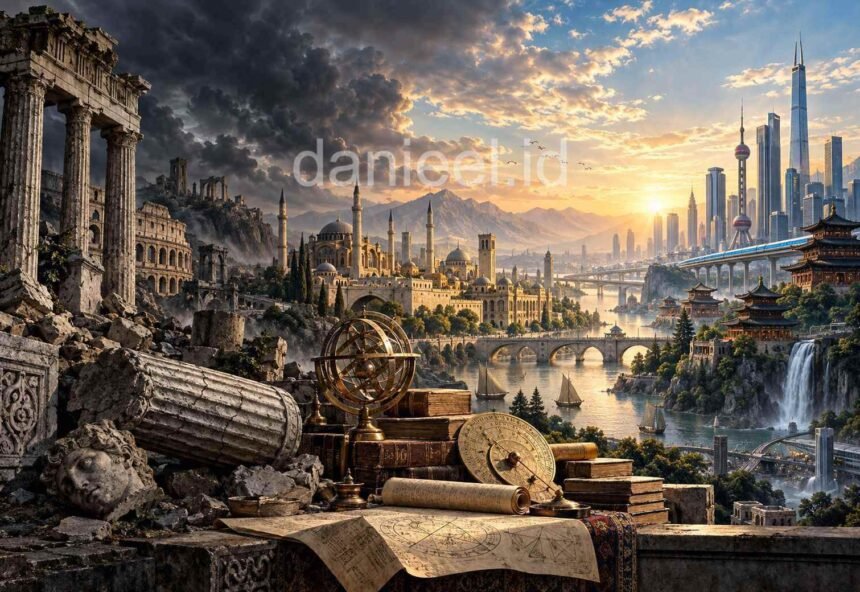
British historian Arnold J. Toynbee is often quoted with one sharp line: “Civilizations die from suicide, not by murder.” As New World Encyclopedia notes, the line sums up his idea that civilizations fall when they fail to answer the challenges of their age. So is it true that great nations are more often brought down by their own weaknesses?
That question is what makes the story of the rise and fall of world civilizations so compelling. The rise and fall of world civilizations is the shifting influence of nations and empires in knowledge, economics, and power from one era to the next: those who once dominated can weaken, and those who lagged behind can overtake them.
Think of a civilization as a grand old family house. A house like that rarely collapses because of a single storm; usually the leaky roof and the termites have been ignored for years, and the storm simply delivers the final blow.
To be fair, history does not turn in exactly the same pattern every time, and “progress” means different things in different eras. Even so, the following seven events show patterns worth comparing. Let’s start in 14th-century Italy.
The European Renaissance

The European Renaissance was a revival of interest in science, art, and classical Greek and Roman texts that grew gradually in the cities of Italy from the 14th century, then spread across Europe and paved the way for the Scientific Revolution.
The Middle Ages are often called the “Dark Ages,” but many historians consider the term an oversimplification: universities, scholastic philosophy, agriculture, architecture, and trade kept developing. The Renaissance was also shaped by printing, trade networks, the patronage of cities and courts, and the exchange of knowledge with the Islamic world. Figures such as Leonardo da Vinci, Gutenberg, Francis Bacon, Descartes, Kepler, and Galileo came from different generations, so they are better seen as part of a long chain that even stretches all the way to the story of the double-slit experiment in quantum physics.
Galileo’s case shows how tangled the relationship between science, authority, and religion can be. In 1633 the Inquisition declared him “vehemently suspected of heresy” for supporting Copernican heliocentrism, and he spent the rest of his life under house arrest. Yet according to the Stanford Encyclopedia of Philosophy, the affair also involved legal procedure, patronage, and papal politics, not simply “science versus religion.”
Advances in navigation, metallurgy, and gunpowder later allowed Europe to trade and conquer at the same time; the bright side of knowledge met the dark side of expansion.
The Decline of Islamic Civilization
The decline of Islamic civilization was not a single event but a series of political, military, and economic shocks that weakened centers of learning such as Baghdad, while scholarly traditions in other parts of the Islamic world lived on.
From the 8th century, Baghdad under the Abbasid Dynasty became a center of politics, trade, and learning. Muslim, Christian, Jewish, Persian, and Arab scholars worked with the heritage of Greece, India, and Persia; the House of Wisdom (Bayt al-Hikmah) became its symbol, although its image as a “modern university” is still debated. Al-Khwarizmi, Ibn Sina, al-Ghazali, and Ibn Rushd are just a few of the names, and their works later helped shape European science through Latin translations.
The Mongol attack on Baghdad in 1258 was a major blow, compounded by the Crusades, political fragmentation, shifting trade routes, and epidemics. The Ottoman Empire itself lasted much longer: the sultanate was abolished in 1922 and the caliphate in 1924.
Interestingly, one of the best-known theories of the cycle of civilizations was born in the Islamic world. The 14th-century Tunis-born historian Ibn Khaldun wrote in the Muqaddimah that dynasties “have a natural life span like individuals”: the strong group solidarity (‘asabiyyah) of the early days is slowly eroded by luxury.
It is worth noting that the claim that “the gate of ijtihad was closed” and that learning then declined is a debated interpretation, as Wael B. Hallaq’s study Was the Gate of Ijtihad Closed? shows. So no religion is destined to advance or decline; a scientific tradition needs institutions, debate, and security that last across generations.
The Era of Colonialism
The era of colonialism was the period when relatively small European states controlled vast territories in the Americas, Asia, and Africa through a combination of seafaring technology, capital, trading companies, local allies, epidemics, and violence.
The formula “Gold, Glory, Gospel” helps us remember the motives: Columbus reached the Caribbean in 1492, and Magellan’s expedition, completed by Elcano, became the first circumnavigation of the globe in 1519–1522.
I am still stunned when I read about the conquest of the Americas. Cortés arrived in Mexico in 1519 with only a few hundred Spanish soldiers, and Pizarro captured Atahualpa in 1532 with fewer than two hundred men (the exact figures vary by source). Yet Cortés was backed by tens of thousands of Indigenous allies who opposed the Mexica/Aztecs, the Inca Empire was torn by civil war, and Old World epidemics devastated the population. Cortés’s letters to the Spanish king at the Library of Congress are an important primary source, but they need to be read critically because they were written to justify himself.
The Industrial Revolution in Britain from the 18th century then boosted production, the demand for raw materials, and military power.
How did small European countries manage to control such vast territories? The answer is not technology alone, but also trading companies, capital, bureaucracy, treaties, divide-and-rule politics, local allies, and violence.
A local example hits close to home for Indonesians. The saying that “the Dutch colonized Indonesia for 350 years” is a popular simplification: the Dutch East India Company (VOC) was founded in 1602, but many regions were only conquered in the 19th or early 20th century. This does not downplay colonialism; instead, it shows how domination was built bit by bit amid resistance that never stopped.
Japan’s Meiji Restoration

The Meiji Restoration was a transfer of power in Japan in 1868, followed by sweeping reforms in government, the military, taxation, education, and industry that turned Japan into a modern industrial nation within a few decades.
Tokugawa-era Japan was not entirely closed; knowledge still flowed in through Dejima in Nagasaki. The arrival of Commodore Perry’s fleet in 1853 pressured Japan to open its ports, and the Treaty of Kanagawa was signed in 1854. The new government then abolished the feudal domains and sent the Iwakura Mission abroad. According to the National Diet Library of Japan, the 1868 Charter Oath promised public deliberation and the pursuit of knowledge throughout the world.
Here, Ibn Khaldun’s observation feels relevant in an unusual way. In the Muqaddimah he wrote that “the vanquished always want to imitate the victor.” Japan did imitate the West, but selectively and before it could be colonized. The difference is like a student who copies a friend’s homework versus one who learns how to solve the problems (the second one’s grades clearly last longer).
That modernization was not free: heavy taxes, samurai rebellions, and later Japanese imperialism are also part of its history. Through Gakumon no Susume (An Encouragement of Learning), Fukuzawa Yukichi emphasized education and independence; his portrait graced the 10,000-yen note from 1984 until it was replaced by Shibusawa Eiichi in July 2024. On a personal scale, a similar spirit of learning can be seen in the soft skills students develop through organizations.
The Collapse of the Soviet Union

The collapse of the Soviet Union in December 1991 happened without any foreign invasion; the superpower dissolved through a combination of economic stagnation, a crisis of legitimacy, nationalism in its republics, political reform, and a failed coup.
The Soviet Union was formally established in December 1922, five years after the Russian Revolution. Its industrialization was rapid, but in its final decades productivity slowed, the bureaucracy grew rigid, and shortages eroded public trust, on top of the burden of the military and the war in Afghanistan.
Mikhail Gorbachev, a figure easy to remember for viewers of the Indonesian evening news program “Dunia dalam Berita” because of the birthmark on his head, introduced glasnost (openness) and perestroika (restructuring). These reforms opened space for criticism while accelerating nationalism in the Soviet republics. The hardliners’ coup in August 1991 failed, Russia, Ukraine, and Belarus declared that the Soviet Union had ceased to exist, and Gorbachev resigned on December 25, 1991, as recorded by the Office of the Historian, U.S. Department of State.
This story echoes historian Will Durant’s line about Rome in Caesar and Christ (1944): “A great civilization is not conquered from without until it has destroyed itself within.” Of course, Gorbachev was not the sole cause; the economy, legitimacy, nationalism, and elite decisions all shaped this chapter in the rise and fall of world civilizations.
The Decline of the United States Economy

The decline of the United States economy is better read as a relative decline: the 2007–2009 financial crisis exposed serious vulnerabilities, but America also showed its ability to respond with policy and recover.
Risky home loans, complex securitization, high leverage, and regulatory failures reinforced one another. Lehman Brothers went bankrupt on September 15, 2008, AIG was rescued, Washington Mutual was closed by regulators, and Fannie Mae and Freddie Mac were placed into government conservatorship. Federal Reserve History notes that the subprime crisis turned when defaults rose and house prices fell.
A framework often used to read this situation comes from Yale historian Paul Kennedy. In The Rise and Fall of the Great Powers (1987), he warned of the danger of “imperial overstretch,” when a superpower’s strategic commitments outgrow its economic capacity, as discussed in The New York Review of Books. By contrast, popular predictions that the dollar would collapse if China or OPEC abandoned it have not come true so far.
America also did not stop going to space after the Constellation program was canceled in 2010; NASA shifted to commercial crew partnerships and the Artemis program. To read a company’s economic health without getting stuck on a single number, we can use the four types of financial statements and financial ratios for performance analysis.
The Rise of China

The rise of China began with the reform and opening-up policy from 1978, which according to the World Bank produced average GDP growth of more than 9 percent a year and lifted nearly 800 million people out of extreme poverty.
As a rough picture, 800 million is almost three times the population of Indonesia. After Mao died in 1976, Deng Xiaoping turned the Four Modernizations, an idea Zhou Enlai had put forward earlier, into a framework for reform: agriculture, industry, science and technology, and defense. Special economic zones and market mechanisms were expanded gradually, and China joined the WTO in 2001. Education, infrastructure, and urbanization also played a role, while inequality, the environment, debt, demographics, and political restrictions remain real problems.
Some stories also need filtering. Zhu Rongji’s quote about “a hundred coffins,” 99 for corrupt officials and one for himself, is very popular, but its primary source is hard to find; the same goes for figures on executions of corrupt officials that circulate without clear documentation.
Its space achievements are easier to verify: Shenzhou 5 carried Yang Liwei into orbit in 2003, Zhai Zhigang performed a spacewalk on Shenzhou 7 in September 2008, and Chang’e 2 orbited the Moon from October 2010, as recorded in NASA’s list of Moon missions. Even so, the assumption that China will inevitably replace America remains a prediction, because the rise and fall of world civilizations rarely moves in a straight line.
Sorting Facts, Interpretations, and Legends
Not every story in the rise and fall of world civilizations carries the same weight of evidence. The table below sorts them out.
| Category | Examples in this discussion |
|---|---|
| Established facts | Galileo’s trial in 1633, the Mongols in Baghdad in 1258, the Soviet dissolution in 1991 |
| Historians’ interpretations | The “Dark Ages,” the causes of scientific decline in the Islamic world |
| Popular simplifications | “350 years of Dutch colonization,” conquest without Indigenous allies |
| Unverified claims or predictions | The “hundred coffins” quote, predictions of the dollar’s collapse |
In other words, the more dramatic a historical story is, the more we need to check its source before forwarding it to a WhatsApp group (usually the quickest to believe anything).
A Few Questions from Readers
What is the main lesson from the rise and fall of world civilizations?
The main lesson is that nations endure not because they never make mistakes, but because they can learn, build trusted institutions, and correct themselves before a crisis turns into collapse.
Was Indonesia really colonized by the Dutch for 350 years?
The figure of 350 years is a popular simplification. The VOC was founded in 1602, but Dutch control was built gradually, and many regions were only conquered in the 19th or early 20th century.
What is Ibn Khaldun’s theory of the cycle of civilizations?
Ibn Khaldun’s cyclical theory holds that dynasties have a natural life span like individuals: they grow from strong group solidarity, weaken as luxury erodes it, and are then replaced by a new group.
The Common Thread in the Rise and Fall of World Civilizations
In essence, these seven events show that knowledge, a productive economy, and defense do matter, but they are not enough. Trusted institutions, education, political legitimacy, diplomacy, and the ability to correct mistakes also determine how resilient a nation is.
In The History of the Decline and Fall of the Roman Empire, Edward Gibbon concluded that Rome’s decline was “the natural and inevitable effect of immoderate greatness,” as cited by the Online Library of Liberty. Back to that grand old house: storms from outside are real, but a house whose roof is regularly patched is usually still standing when the storm passes.
The Qur’an also reminds us:
“And these days [of varying conditions] We alternate among the people” (QS. Ali ‘Imran: 140, Sahih International).
French historian Marc Bloch wrote in The Historian’s Craft that “misunderstanding of the present is the inevitable consequence of ignorance of the past.” The first step is simple: when you come across a historical claim that sounds too dramatic, ask for its source first.
Of these seven events, which fact most changed the way you used to see history? I’m curious to read your answer in the comments.”
The nations that endure are not those that never fall, but those that know how to rise again.
This post is also available in: