






A near-perfect GPA or experience chairing an event committee: which one catches a recruiter’s eye? The answer may not be as simple as we think. In the Job Outlook 2026 survey by NACE in the United States, 70% of employers said they use skills-based hiring for entry-level graduates, up from 65% the year before.
For many people, including me, university years are among the most beautiful chapters of life. That is what makes them a golden opportunity to build soft skills for students through campus organizations, skills whose value we feel later at work and in social life.
Soft skills are non-technical abilities, such as communication, teamwork, and leadership, that only grow through practice. Student organizations, such as department associations, student councils, clubs, or event committees, provide a place to practice them in real situations. Think of it like riding a bicycle: reading the manual does not teach us how to pedal. Theory gives us a map, but experience is what actually gets our feet moving.
This article began as material I presented as a speaker at a leadership and organizational development training held by a student association in March 2021, so that those who could not attend could read it too.
Why Do Soft Skills for Students Matter?
Soft skills for students matter because a GPA alone is not enough to get through job selection: after the administrative stage, candidates are still judged on how they explain ideas, work with others, and show responsibility.
GPA does matter, and some companies use it for initial screening. However, the same NACE survey found that 73% of employers that do not screen by GPA, and 67% of those that do, still consider whether candidates have demonstrated proficiency in key competencies. In other words, a GPA opens the door, but skills are what get us invited to take a seat.
The same idea appears in the NACE career readiness framework and in Bill Coplin’s book, 10 Things Employers Want You to Learn in College, the foundation of the Skills Win curriculum at Syracuse University.
If you are still a student, it would be a shame to spend these years only attending lectures and going straight home, or just hanging out at the mall. Organizations give us a social laboratory. As a bonus, who knows, you might meet your future spouse in the association. An unofficial and highly unscientific danieel.id survey found at least one successful case: me, hehe.
Of course, organizations are not the only path; internships, communities, or part-time jobs can also be places to learn. Still, organizations offer many real situations all at once. Here are ten soft skills that, in my experience, are most likely to be developed there.
Communication Skills

Communication skill, perhaps the most basic of all soft skills for students, is the ability to deliver a message clearly so the listener or audience understands it, not just the ability to talk a lot. Some people are born chatty, or nyenyes as people in Palembang say, but a lively talker is not always able to get a message across clearly.
In organizations, I learned to speak with peers, seniors, lecturers, and even heads of institutions. When organizing a national seminar, I once met with the governor and several leaders of state-owned enterprises, regional state-owned enterprises, and private companies in my region to look for sponsors. Of course, speaking with them was very different from chatting with classmates.
When interviewing job applicants, I also saw the difference between grades on paper and the ability to explain oneself. To be fair, that is my experience, not a universal law that activists are always better. The lesson: students chasing a high GPA still need to practice communication, while organization activists should not forget to study. Keep it balanced, guys.
Teamwork Skills

Teamwork is the ability to contribute ideas while still listening to and supporting the group’s decisions, because no one can be great alone. In a leaderless group discussion test I once took, participants were asked to solve a problem without an appointed leader.
From my observation, the person who keeps dominating does not necessarily perform best, and the one who only nods along does not help much either. Healthy contribution lies between the two: sharing opinions, listening, finding middle ground, and summarizing decisions.
In a committee, sometimes our idea is accepted; other times someone else’s idea is chosen, and we still have to help carry it out. That is the art of working together.
Interpersonal Skills

Interpersonal skills are the ability to build and maintain relationships with others, including when there is competition and conflicting interests. Organizations are not always as pretty as group photos on social media; there is rivalry and ego, including my own.
In my third year of university, I felt I was the most qualified person to chair the department association. The problem was that six classmates felt the same way, while the batch below us united behind a single candidate. If seven people from my batch ran at once, we risked losing because our votes would be split.
After some discussion, six of us, including me, stepped aside and backed one candidate. Our candidate eventually won. More importantly, we stayed friends, including with the candidate from the rival batch (who had briefly wrecked our personal ambitions).
From that experience, I learned one of the most valuable soft skills for students through organizations: maintaining relationships does not mean avoiding differences. Sometimes we need to step forward, sometimes we need to step back, and almost always we need to talk with a cool head.
Responsibility

Responsibility is the willingness to finish the duties we have accepted, however small, without needing constant supervision. A position on a committee or board is not just an extra line on a CV.
Even a catering coordinator has to plan quantities, distribution times, quality, and budget. In organizations, it is easy to see who completes their duties and who disappears until the term ends. That is where we learn to motivate ourselves, a habit that later shapes professionalism at work.
Delaying a thesis can happen for many reasons, not always laziness. But for me, the habit of finishing small obligations is practice before accepting bigger responsibilities.
Leadership Skills
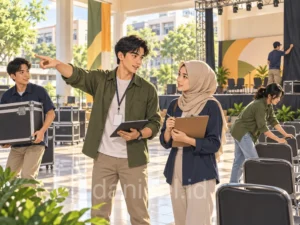
Leadership in student organizations can be practiced on a small scale, such as section coordinator, committee chair, division head, or association chair. There is no need to wait for the top position.
Leading students is sometimes more challenging than leading formal subordinates, because we do not pay committee members. If they are removed, they might actually be happy because their workload shrinks. So, what makes people willing to follow us? In my experience: clarity, setting an example, how we treat people, and the courage to make decisions.
I still remember an association chair who faced a proposal to postpone a welcoming event for new students even though the posters had already gone out. He decided briefly and firmly: the event would go ahead as scheduled, then invited everyone to work together. The event took place without any split. Leaders do need to listen to input, but at the right time they must decide and take responsibility.
For me, leadership does not stop being learned once someone holds a position, as I shared in my article on the reasons to choose the MBA program at SBM ITB.
Organizational Skills

Organizational skills are the ability to understand the structure, rules, hierarchy, and relationships between units within an organization, including a company. When I did an internship at a company, a supervisor asked, “What is the first thing you need to know when you join a company?” I answered, “The company profile?” My friend guessed the business process. His answer: the organizational structure.
We need to understand our own position, our direct superior, other functions related to our work, and the limits of each person’s authority.
When I was active in the association, I actually enjoyed members’ assemblies that discussed the bylaws article by article until late at night. The difference between the words “and” and “or” could trigger a storm of interruptions, sometimes spiced up with table-banging (quite dramatic, looking back). That is where I learned to read rules and hierarchies, a skill that proved useful when dealing with procedures and regulations at work. Or at least, that is what I think, being someone who tends to flatter himself, hehe.
Entrepreneurial Skills

Entrepreneurial skills in an organization are the ability to sell ideas, programs, goods, or services to cover funding needs, even for students who have no plans to become business owners. A limited treasury and the typically thin wallets of students force committee members to get creative.
I once chaired the fundraising section for a new-student orientation event. The committee needed to print a pocket book. To make it attractive to sponsors, we turned it from a simple book for collecting seniors’ signatures into one containing the academic calendar, the department’s history, the bylaws, and a list of lecturers.
With that mock-up, the team visited printing shops, photocopy shops, and computer accessory stores, offering ad space while explaining who the readers would be. Ten sponsors joined, and the funds raised exceeded the printing cost. The book, you could say, was already profitable before it was published.
Time Management

Time management is the ability to set priorities when lectures, meetings, committee tasks, and personal life all demand attention at the same time.
During university, I divided my time between classes, association activities, working as an assistant in the basic physics and computer laboratories, and teaching at a tutoring center to earn extra pocket money. I did not always manage it perfectly, but the packed schedule forced me to plan ahead and cut back on the habit of last-minute cramming.
Self-control also shapes how we use our time, as discussed in the lessons on self-control from the Marshmallow Test.
Creativity

Creativity in an organization means daring to bring new ideas into the work program, rather than copying last year’s activities.
During the 2020–2021 pandemic, committee members had to rack their brains to keep online events on Zoom or Google Meet from being boring. Limitations often force us to find new ways.
In the World Economic Forum’s Future of Jobs Report 2025, creative thinking as well as resilience and flexibility are among the skills expected to become more important through 2030. Organizations are a relatively safe place to try out ideas and receive criticism.
Ability to Work Under Pressure

Working under pressure is the ability to keep delivering a plan when deadlines are tight, staff is limited, funds are scarce, or colleagues are less than supportive. Organizations and companies both bring such pressure, to different degrees.
In 2002, I initiated the Alumni Data Book, an early effort in my association and department to collect data on thousands of alumni. The internet was not as easy to use as it is now, and I did not yet own a computer or a mobile phone. Our team typed at one computer rental shop after another, borrowed space in the head of department’s office, contacted alumni through email and mailing lists, and distributed paper forms.
With limited funds and our term almost over, one team member came back after being mocked by an alumnus at a government office: “Why bother collecting data like this? Got nothing better to do!” That comment almost made us want to quit. Thanks to the support of friends, the book was finally published on time.
That story, a real example of soft skills for students built through organizations, was something I later shared in a job interview when asked about my most meaningful contribution in an organization. I am not sure how much it influenced the result, but I could answer with a real example, not a memorized answer.
How to Build Soft Skills Without Sacrificing Your Studies
The safest way to build soft skills for students through organizations is to choose just one or two activities, then take on responsibilities with visible results. The goal is not to become the busiest student on campus.
Start with small, clear tasks; there is no need to chase the chair position right away. Here is a simple picture:
| Committee task | Soft skills practiced |
|---|---|
| Taking meeting minutes | Capturing the key points of a discussion |
| Contacting speakers or sponsors | Communication |
| Handling catering | Planning and budget discipline |
| Event coordinator | Delegating tasks and making decisions |
So, even a small role is enough to start practicing. After an activity ends, reflect: what worked, where did the team get stuck, and did we listen or were we busy winning arguments? Without reflection, the same mistakes repeat easily.
Keep your limits, too: if your grades fall apart or your health suffers, reduce the load. I love organizations, but I do not recommend sacrificing academic obligations just to look active.
Keep reasonable records of your work, such as proposals or activity reports, so you can later tell concrete stories on your CV or in interviews: the problem, your actions, and the results. That is far stronger than writing “has leadership qualities.” These habits remain useful after graduation, as in these tips to become an effective and reliable worker.
Soft Skills Must Be Practiced, Not Memorized
In short, a GPA opens the door, while soft skills for students through organizations help us step inside and stay there. The ten soft skills above are not an absolute scientific list, but choices drawn from my experience; others may rank them differently.
Just like riding a bicycle, we still need to pedal, lose our balance, and try again. Organizations provide a place for that practice, with small failures as inexpensive lessons.
I always remember two pieces of advice from my parents. My late father said, “You do need to be smart, but it is even more important to be calak.” In the Palembang language, calak roughly means clever and good at strategizing. My late mother advised, “You must be good at ngawak diri,” meaning knowing how to carry yourself and maintain good relationships with others.
So, pursue good grades as best you can, but do not stop at the classroom. The first step is simple: choose one activity that fits your schedule, take on one real responsibility, finish it, then reflect on what you learned.
University years are limited and cannot be repeated. Use them to create work and memories that will be sweet to tell one day.
Of the ten soft skills above, which one did you gain most from organizations, or did it come from internships and communities instead? I am curious to read your answer in the comments.
Hope this is useful.
This post is also available in: