







Saturday morning. While some of my office friends were still deciding between a morning jog and a few more hours of sleep, I was already sitting in a theater-style classroom in Jakarta, ready to field questions from the lecturer until late afternoon. That weekend ritual ran for my entire study period, and strangely enough, I enjoyed it.
The SMEMBA MBA, short for Strategic Marketing Executive MBA, is an executive MBA program at the Jakarta campus of SBM ITB (the School of Business and Management, Institut Teknologi Bandung), run in collaboration with MarkPlus Institute. Classes are held on weekends, so participants can study while keeping their jobs. I am an alumnus of Batch 3, class of 2019–2020. To me, the SBM ITB and MarkPlus partnership is not just a nice name to print on a brochure; I felt it myself in the classroom.
Think of choosing an MBA program as choosing a gym. A big name, complete equipment, and skilled trainers all matter, but muscles only grow if we actually show up and sweat. A fun workout buddy also makes us want to come back the following week.
One thing to clear up first: this is a personal experience, not an objective ranking. Think of it as a testimonial for my beloved alma mater and a keepsake of the good times I had in graduate school. My experience took place from 2019 to early 2020, before the COVID-19 pandemic, so schedules, lecturers, curriculum, fees, and admission requirements may have changed. For the latest information, please check the official Strategic Marketing Executive MBA page.
There are ten reasons that made me confident in choosing the SMEMBA MBA at SBM ITB. Let’s start with the one that is most visible from the outside: the name.
The Big Name of ITB

The reputation of Institut Teknologi Bandung (ITB) was my first consideration when I started looking at the SMEMBA MBA. Who in Indonesia hasn’t heard of ITB? Reputation is not the only reason to choose a school, but honestly, it gave me confidence when deciding where to study again.
SBM ITB itself was founded on December 31, 2003. Its history, academic programs, and position within ITB are described on the official SBM ITB profile. I deliberately avoid fixating on specific ranking numbers because rankings change every year. What matters more to me is the academic ecosystem, the quality of learning, and the experience I actually had.
As part of ITB, SBM brings academic standards along with a large network. That was the first door that made me take this program more seriously.
A Brilliant Collaboration Between SBM ITB and MarkPlus Institute

The partnership between SBM ITB and MarkPlus Institute allows the SMEMBA MBA to blend business theory from academics with marketing experience from practitioners. In my experience, the mix is just right: well-structured concepts meet real-world application.
The collaboration also opens doors to marketing events, discussion forums, and alumni activities. I still occasionally receive invitations to attend or even speak at events held by SBM ITB or MarkPlus. So the benefits don’t stop when the final exam is over.
In terms of institutional quality, SBM ITB earned international accreditation from ABEST21 in 2018 and from AACSB in 2021. The latest status and review cycle can be checked on the SBM ITB Quality Assurance and Accreditation page. Accreditation doesn’t guarantee that every student will have the same experience, but it is a fair indicator to consider.
Engaging Teaching Methods That Push Students to Be Active
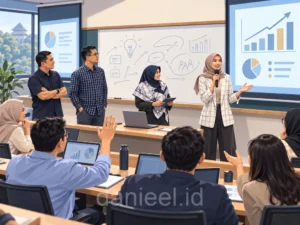
Classes in the SMEMBA MBA in my day required students to ask questions, answer them, dissect case studies, hold group discussions, and give presentations, which kept weekend classes lively from morning to late afternoon. If it had been nothing but one-way lectures, well, it could have turned into a festival of fighting off sleep.
Class participation was also part of the grading in my class. As a result, we were motivated to come prepared. Meaningful participation, of course, not just talking for the sake of talking (or as we say in Indonesian, asal njemplak).
Well, at the very least, read up on the theory and the case study before class, so you don’t freeze when the lecturer calls on you or go off on a tangent during discussions, hehe.
Don’t expect an A if you just sit quietly without saying a word, let alone sneak in an afternoon nap during class. At least, that’s how things were in Batch 3.
Up-to-Date and Relevant Course Material

The SMEMBA MBA curriculum in my period covered marketing, operations and supply chain, accounting, finance, business economics, consumer behavior, strategy, law and sustainability, brand communication, organization, and negotiation.
The official course list may change, so prospective students should compare my story with the latest SMEMBA program structure. What I liked back then was how theory was brought together with real cases.
When we studied accounting, for example, we analyzed the financial statements of an Indonesian state-owned enterprise that was making headlines at the time. In business strategy, we discussed the marketing strategy behind the Marvel films that were booming back then. The material felt close to the working world, not just a collection of definitions to memorize.
My favorite was finance management. That course helped me understand financial statements, the time value of money, risk and return, capital budgeting, the cost of capital, and valuation. For readers who want to dig deeper, I’ve written several finance articles on this website, for example about the four types of company financial statements and stock valuation methods.
“Wow, where have I been all this time? How did I only just learn something this important?”
That was honestly what I muttered to myself when the lecturer explained how financial theory connects to its use in the real world. That doesn’t mean everyone will fall in love with the same course; this is purely my personal favorite.
Capable Lecturers: A Mix of Academics and Practitioners

The SMEMBA MBA lecturers in my time were a combination of academics and experienced practitioners, which made the collaboration between the two institutions come alive in the classroom. I deliberately don’t list their names and titles here because the teaching lineup can change.
What impressed me most was the combination itself. Academics helped us understand concepts in a structured way, while practitioners brought stories about how those concepts collide with targets, budget limits, office politics, and market realities.
Several courses also featured guest lecturers from business and government. The theory we had just learned was immediately tested against field experience. Sometimes it confirmed the theory; sometimes it made us realize that the real world is far more stubborn than the diagrams in a textbook.
Fun Classmates from Many Professional Backgrounds

My SMEMBA MBA batch had around 45 students from state-owned enterprises, banking, government ministries, automotive, consumer goods, technology, and other sectors. That diversity enriched our discussions because a single problem could be seen from many angles.
As it happened, my classmates were also fun and close-knit. We chatted between classes and sometimes continued hanging out at the mall next door, Kokas, after class (the official excuse was a “follow-up discussion,” but it usually ended with a hunt for food). We even made batch jackets and held a kind of family gathering before the pandemic. To this day, the Batch 3 alumni group is still active.
Still, this is my batch’s experience. Class bonding can’t be promised by a brochure or a curriculum; it grows from people who happen to meet and are willing to nurture the relationship.
Lively Case Study Discussions

Case study discussions were the part I enjoyed most about graduate school in the SMEMBA MBA. Challenging cases, skilled facilitators, and a diverse student body made the perfect recipe for warm discussions, sometimes heated ones, but always cheerful.
We once debated why Nokia and BlackBerry, which had once led the mobile phone market, were eventually pushed out. We also discussed ZARA’s sourcing strategy: is it better to cut costs by outsourcing production to countries with lower labor costs, or to keep a local, in-season, and vertically integrated production model?
In the People in Organization course, we dissected the Aditya Birla Group case. The debate touched on HR restructuring, hiring outside professionals for top management positions, redesigning the performance management system, and shifting the hierarchy from seniority to performance.
Oh, I really miss heated debates like that.
English as the Language of Instruction

Lectures, assignments, exams, group discussions, and the thesis in the SMEMBA MBA were all in English during my period. Of course it was challenging at first, especially when we had to build arguments on the spot during discussions. But that’s exactly where the real practice happened.
The program gave me a chance to polish my English again in a business context. My batch even had two international students, one from Italy and one from China. Their presence added color to the class.
I don’t want to claim that studying in English automatically makes every graduate ready to compete internationally. Readiness still depends on each person’s ability and effort. But a learning environment like that does provide real room for practice.
An Impressive Lecture Theater
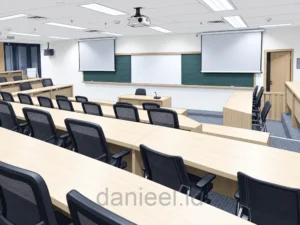
SMEMBA classes in my time were held at the Philip Kotler Theater on the 8th floor of the EightyEight@Kasablanka building, a theater-style room that stays comfortable even when you sit from morning to late afternoon. Each row is set at a different height, so we didn’t have to keep craning our necks to see the board or the screen.
The multimedia and audio facilities also supported the learning process. The room wasn’t my main reason for taking an MBA, but it was clearly a small, pleasant bonus. If you have to spend your weekends in class, at least the classroom should make you want to stay.
The good news is that the SMEMBA MBA still uses the Philip Kotler Theater today. So prospective students can still experience the same lecture room.
A Strong Alumni Network

Graduates of the SMEMBA MBA can join the ITB and MBA ITB alumni networks, communities known for being close-knit and far larger than a single class. I joined them myself. In 2021, I took part in the election for the chair of IA-ITB, the ITB alumni association.
An alumni network is an added value for expanding friendships, exchanging information, and opening opportunities for collaboration. However, a network is not a magic machine that instantly produces opportunities. We still have to show up, contribute, and build trust. An alumni card alone is certainly not enough (if it were, my wallet would have been thick a long time ago, hehe).
For those still in undergraduate school who want to sharpen their organizational skills first, my article on soft skills students can build through campus organizations could be a good companion read.
Summary: 10 Reasons to Choose the SMEMBA MBA
The table below summarizes the ten reasons above: what I experienced as an alumnus, and what you should consider before applying.
| Reason | What I experienced | What you should consider |
|---|---|---|
| The big name of ITB | Confidence in choosing a school | SBM ITB’s profile and accreditation |
| SBM ITB–MarkPlus collaboration | Theory meets marketing practice | Joint events and activities |
| Active learning methods | Weekend classes stay lively | Time to prepare readings and cases |
| Relevant course material | Theory taught through real cases | The latest course structure |
| Academic and practitioner lecturers | Clear concepts plus field stories | The current teaching lineup |
| Classmates from many professions | About 45 professionals across sectors | Willingness to nurture friendships |
| Case study discussions | Debates on Nokia, ZARA, Aditya Birla | Fit with your learning style |
| English instruction | Business communication practice | Readiness to speak spontaneously |
| Philip Kotler Theater | A theater-style room worth staying in | Weekend class schedule |
| Alumni network | Friendships and collaboration | Willingness to stay active |
In other words, some of these reasons can be checked in a brochure, but others only pay off when we take an active part in them.
Frequently Asked Questions
What is the SMEMBA MBA at SBM ITB?
The SMEMBA MBA is the Strategic Marketing Executive MBA, an MBA program at SBM ITB’s Jakarta campus offered in collaboration with MarkPlus Institute. Its latest structure should always be checked on the official SBM ITB website.
Is SMEMBA suitable for people who keep working full time?
Yes, the program is designed for executives, with classes on weekends. In my experience, this format makes it possible to study while working, although readings, assignments, discussions, and exams still demand a serious time commitment.
How long does the SMEMBA MBA take?
The official program page lists a duration of 18 months, made up of three regular semesters and one short semester. This information may change, so prospective students should check the latest admissions page.
Does the experience in this article still apply today?
Not necessarily, because my experience comes from Batch 3 in 2019–2020. Lecturers, schedules, courses, teaching methods, fees, and admission policies may change, so this article is best read as an alumnus’s notes, not an official brochure.
So, Is the SMEMBA MBA Right for You?
In short, the ten reasons above explain why this program was right for me, not a guarantee that it will suit everyone.
Back to the gym analogy: SMEMBA SBM ITB provides great equipment, trainers, and workout buddies, but the results still depend on how often we show up and sweat. Choosing an MBA program is a personal decision. Consider your career goals, your interest in strategic marketing, your availability on weekends, your finances, support from your family and employer, and your learning style. The first step is simple: open the official program page, then match the curriculum, schedule, fees, and requirements with your current situation.
If you’re weighing an MBA, which matters most to you: the school’s name, the teaching method, the schedule, or your future classmates? I’m curious to read your answer in the comments, and you’re welcome to ask questions about my experience there too.
Sometimes the best decision is not choosing the most famous school, but choosing the one where we are most likely to grow.
This post is also available in: