







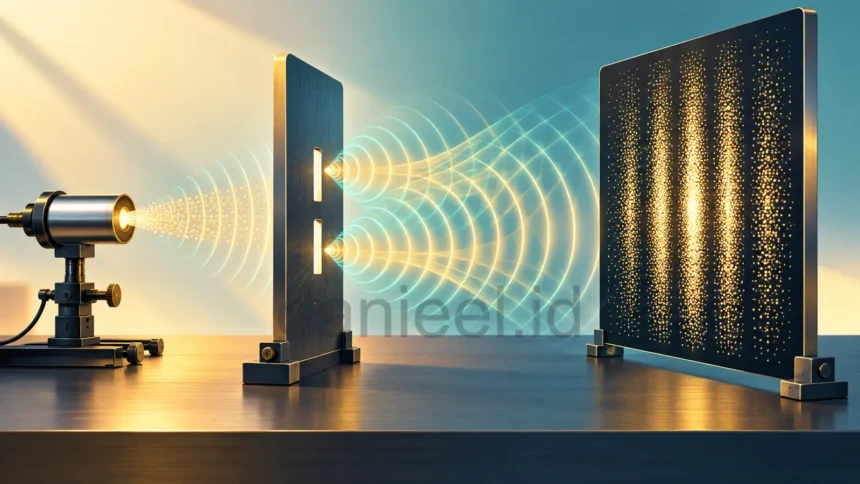
Ever tossed a pebble into a fish pond and watched the ripples spread out, run into each other, and form a beautiful pattern? That simple sight turns out to be the key to the most baffling experiment in the history of science. Nobel laureate Richard Feynman even said this experiment holds “the only mystery” of quantum mechanics.
This is where the double-slit experiment takes the stage. The double-slit experiment fires light or extremely tiny particles, such as electrons, at a barrier with two narrow slits, then looks at the pattern that forms on a screen behind it. The results show that very tiny things can behave like waves and like particles, depending on how we measure them.
Well, the double-slit experiment is a bit like playing marbles in front of a wooden fence with two gaps in it. If we throw marbles over and over, we would expect the wall behind it to show just two clusters of dents, one right behind each gap. Now imagine those dents forming stripes instead, like the pond ripples we just pictured. Strange, right? That is exactly what happens with electrons, and it has physicists shaking their heads, hehe.
A quick honest note: this article deliberately simplifies physics that, in its original form, is full of math. Physicists also agree on what the experiment shows, but they still disagree about what it ultimately means.
To keep things in order, let’s follow this experiment from its beginnings all the way to what it means for us today. We start with an English physician and scientist in the early 1800s.
Thomas Young Showed That Light Behaves Like a Wave
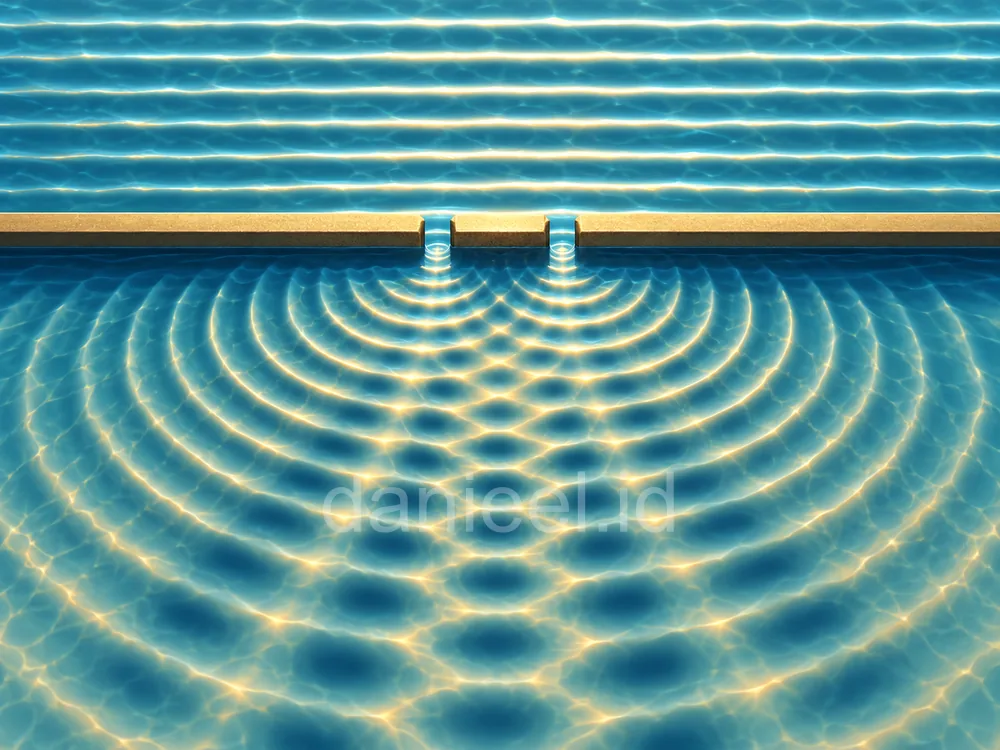
The double-slit experiment was first carried out by English scientist Thomas Young in the first decade of the 19th century, and it showed that light passing through two slits forms a pattern of bright and dark stripes, just like water waves. This finding challenged the popular view, inherited from Isaac Newton, that light is made of tiny particles.
It works much like two stones dropped into a pond at the same time. Where the crest of one ripple meets the crest of another, the waves reinforce each other and form a bright stripe. Where a crest meets a trough, the waves cancel out and form a dark stripe. This striped pattern is what we call an interference pattern.
According to science historian Robert P. Crease writing in Physics World, Young’s experiment is often dated to 1801, although his full account was not published until 1807.
Electrons Fired One at a Time Still Form a Wave Pattern
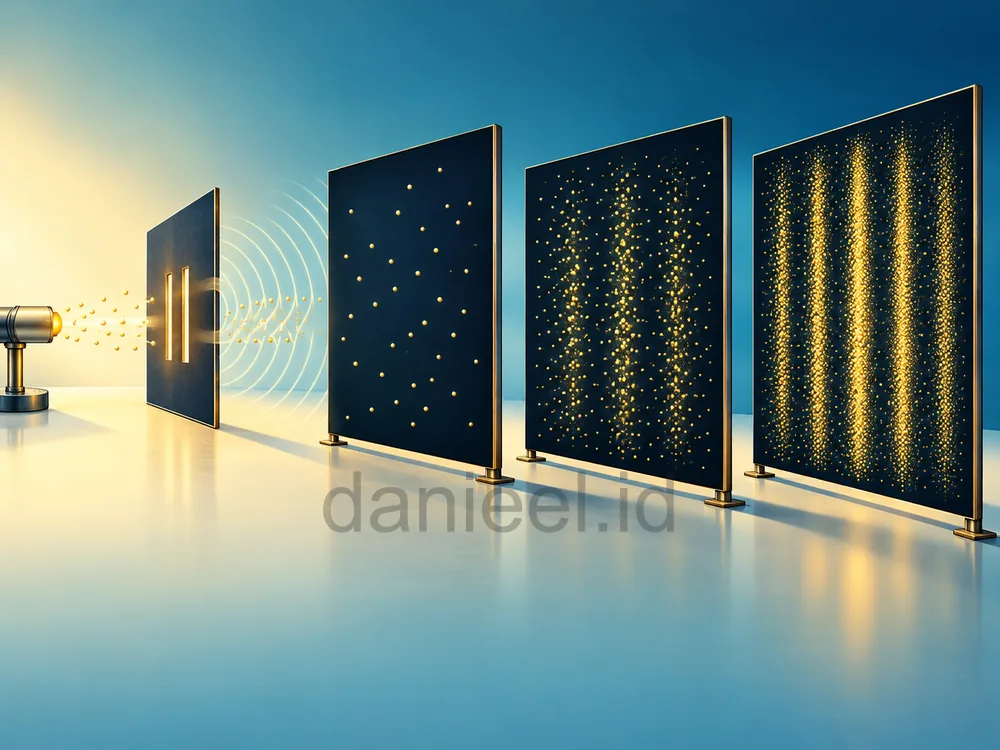
When electrons are fired one at a time through two slits, each electron lands as a single small dot on the screen, yet thousands of these dots slowly build up the bright-and-dark stripes typical of a wave. This is the moment the double-slit experiment turns into physics’ greatest puzzle.
The electron version was first performed by Claus Jönsson in Tübingen, Germany, in 1961, and then with single electrons by a team in Bologna, Italy, in 1974. The most famous version came from Akira Tonomura’s team at Hitachi, Japan, published in the American Journal of Physics (1989). They used an electron biprism that works like two slits and kept the flow below 1,000 electrons per second, so there were never two electrons inside the apparatus at the same time.
With 8 electrons, the screen looks random; with 2,000 electrons, faint stripes start to appear. After about 60,000 electrons over more than 20 minutes, the interference pattern is clearly visible. As a rough calculation, that works out to an average of only about 50 electrons per second or fewer, arriving one by one.
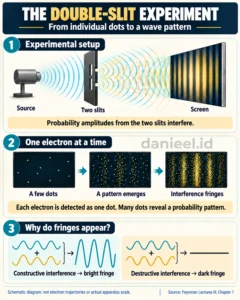
Here is the intriguing part: if each electron arrives alone, what is it interfering with? According to quantum mechanics, before it lands, each electron behaves as if it passes through both slits at once as a wave of possibilities, and then “interferes with itself.”
Once the Path Is Measured, the Interference Pattern Disappears
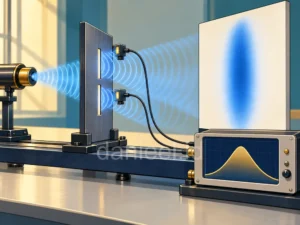
If a detector is placed to record which slit each electron passes through, the interference stripes vanish. In a simplified picture, the screen may show two bands, much like two clusters of dents from marbles going through each gap. (Depending on the setup, however, these two distributions may appear separate or overlap into one broad region.) This is the part of the double-slit experiment that most often leaves people speechless.
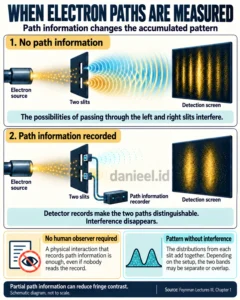
This scenario is described in The Feynman Lectures on Physics, Volume III, Chapter 1. To find out an electron’s path, we have to “nudge” it, for example by shining light on it, and a nudge strong enough to reveal its path turns out to be strong enough to wipe out the interference pattern too. Niels Bohr called this complementarity: the wave and particle aspects complement each other, but they cannot both be fully captured at the same time.
Now, one thing needs clearing up: an “observer” in quantum physics does not mean a conscious human looking on. It means any physical interaction that leaves a trace of information about the particle’s path, such as a detector or a photon. So the electron is not acting “shy” because it knows it is being watched; it changes its behavior because it has actually been touched by the measuring device.
Not Just Electrons: Molecules of Thousands of Atoms Interfere Too

Wave behavior turns out not to belong only to light and electrons; C60 fullerene molecules containing 60 carbon atoms in 1999, and molecules of up to 2,000 atoms in 2019, were also shown to form interference patterns.
The team of Markus Arndt and Anton Zeilinger at the University of Vienna reported the interference of C60 molecules in the journal Nature (1999). These molecules are shaped like a tiny soccer ball. Two decades later, the same group broke its own record in a study by Fein et al. in Nature Physics (2019): molecules of up to 2,000 atoms with a mass of more than 25,000 atomic mass units.
To put it roughly, a single electron has a mass of about 1/1,836 of an atomic mass unit. So a molecule weighing 25,000 atomic mass units is about 46 million times heavier than an electron, yet it still “goes through both slits at once.” So why can’t our car pass through two toll gates at once? (If it could, the queue would clear in no time, hehe.) The answer is that large objects have extremely small wavelengths, and they constantly interact with the air, light, and heat around them, so their interference patterns keep getting erased. This process is called decoherence.
The table below sums up two centuries of this experiment.
| Year | Researchers | What passed through | Key finding |
|---|---|---|---|
| Early 1800s | Thomas Young | Light | Light forms an interference pattern like a wave |
| 1961 | Claus Jönsson | Electrons | Electrons also form an interference pattern |
| 1989 | Tonomura et al. | Single electrons | The pattern builds up gradually from electrons arriving one at a time |
| 1999 | Arndt, Zeilinger et al. | C60 molecules (60 atoms) | Molecules also behave like waves |
| 2019 | Fein, Arndt et al. | Molecules of up to 2,000 atoms | Interference record for objects above 25,000 atomic mass units |
In other words, this result is no fluke; it keeps repeating with larger and larger objects.
What Did Scientists Say About the Double-Slit Experiment?
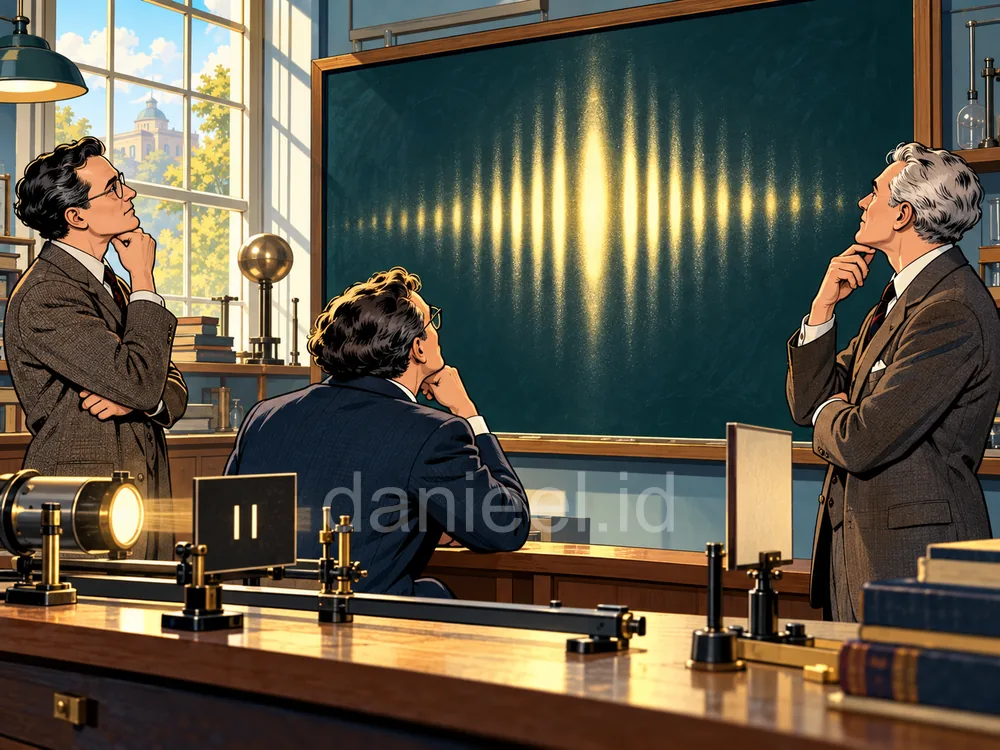
The great physicists of the 20th century admitted that the results of the double-slit experiment are deeply strange, and their words blend wonder, bewilderment, and humility.
Richard Feynman, winner of the 1965 Nobel Prize in Physics, wrote in The Feynman Lectures on Physics that this experiment is “a phenomenon which is impossible, absolutely impossible, to explain in any classical way, and which has in it the heart of quantum mechanics. In reality, it contains the only mystery.”
In his book The Character of Physical Law (1965), Feynman was also refreshingly candid: “I think I can safely say that nobody understands quantum mechanics.”
Niels Bohr, winner of the 1922 Nobel Prize in Physics, is remembered by his student Werner Heisenberg in the book Physics and Beyond as having said: “Those who are not shocked when they first come across quantum theory cannot possibly have understood it.”
Werner Heisenberg, winner of the 1932 Nobel Prize in Physics, wrote in Physics and Philosophy (1958): “What we observe is not nature itself, but nature exposed to our method of questioning.”
Albert Einstein, on the other hand, was uneasy. Abraham Pais recalled in his article in Reviews of Modern Physics (1979) that Einstein once stopped in the middle of a walk and asked him:
whether he really believed that the moon exists only when he looks at it.
No wonder that in a 2002 Physics World reader poll, the double-slit experiment with electrons was voted the most beautiful experiment in physics, while Thomas Young’s light experiment came in fifth.
What the Double-Slit Experiment Means for Modern Physics

The double-slit experiment became a foundation of quantum mechanics because it reveals three key ideas at once: wave-particle duality, superposition, and a nature that works by probability.
Wave-particle duality means light and matter cannot be classified as only waves or only particles; which side shows up depends on how we measure them. Superposition means that before it is measured, a particle can exist in a blend of several possibilities, such as “through the left slit” and “through the right slit.” Probability means physics cannot predict where a single electron will land, but it can predict the pattern formed by thousands of electrons with remarkable precision.
The good news is that quantum understanding is the basis of the transistors inside the chip of the phone you may be holding right now, the lasers in the barcode scanners at the convenience store checkout, and electron microscopes, which use the wave nature of electrons to see things too small for a light microscope. Quantum computers also work with superposition and interference.
The Philosophical Meaning in Everyday Language

Philosophically, the double-slit experiment makes us rethink three things: whether reality is already fixed before it is measured, whether nature works by probability, and how far the human mind can understand the world.
First, about reality. We are sure the sandals by the front door are still there even when no one is looking. In the quantum world, a property like “which slit it went through” does not seem to have a definite answer until a measurement is made. This is what prompted Einstein’s question about the moon.
Second, about probability. In a 1926 letter to Max Born, Einstein expressed his conviction that God “does not play dice.” Yet it is precisely these probability-based predictions that keep passing every test.
Third, about the limits of knowledge. Physicists have several different “stories” to explain the same result. According to the Copenhagen interpretation, an electron really has no definite position until it is measured; it is the measurement that makes it “choose” one spot. According to the many-worlds interpretation, every possibility actually happens, but in different branches of the world. Meanwhile, pilot-wave theory holds that an electron is always a particle with a definite path, except that it is accompanied by a wave that “guides” its direction, much like a small boat carried along by the waves. It is that wave that passes through both slits and forms the pattern. All three fit the experimental results equally well. A 2025 Nature survey of more than 1,100 researchers found that 36% of respondents favored the Copenhagen interpretation, 15% chose many worlds, and 7% chose pilot waves. Interestingly, only 24% were confident their chosen interpretation was correct. In other words, the experts agree on “what happens,” but still disagree on “what it means.”
Electrons too small to see turn out to follow rules so precise that thousands of random dots arrange themselves into an orderly pattern. Subhanallah (Glory be to God). Of course, we cannot equate the Quran with any theory of physics, because scientific theories can always be revised. Still, this sense of wonder at the order of nature is in harmony with Allah’s invitation to those who reflect:
“Indeed, in the creation of the heavens and the earth and the alternation of the night and the day are signs for those of understanding. Who remember Allah while standing or sitting or [lying] on their sides and give thought to the creation of the heavens and the earth, [saying], ‘Our Lord, You did not create this aimlessly; exalted are You [above such a thing]; then protect us from the punishment of the Fire.'” (Quran 3:190–191, Sahih International translation)
You are, of course, free to draw your own conclusions about its deepest meaning. But one thing is certain: the deeper humans explore nature, the clearer it becomes that what we do not yet know is far greater than what we already understand.
Frequently Asked Questions

What is the double-slit experiment in simple terms?
The double-slit experiment sends light or tiny particles through two narrow slits to see what pattern appears on a screen. If the pattern is made of bright and dark stripes, the object is behaving like a wave. Electrons and molecules turn out to produce this pattern too.
Does human consciousness affect the result of this experiment?
No. According to mainstream physics, what changes the result is the physical interaction with the measuring device, not the consciousness of whoever is watching. A detector that records an electron’s path is enough to erase the interference pattern, even if no human ever reads it.
Why don’t large objects show interference patterns?
Large objects have extremely small wavelengths and constantly interact with their surroundings, so their patterns are erased right away.
Closing: Let’s Pause Now and Then and Let Ourselves Be Amazed

To sum up, the double-slit experiment began with Thomas Young’s light, moved on to single electrons that still form a wave pattern, showed that measurement changes the outcome, held true all the way up to molecules of 2,000 atoms, and gave birth to the foundations of modern physics as well as philosophical questions that remain open.
Who would have thought that super-tiny “marbles” passing through two slits could leave the world’s best physicists speechless for more than a century? Start small: the next time you see ripples in a pond or light streaming through a gap in the window, remember the remarkable order behind it. Who knows, that simple sense of wonder may spark a bigger curiosity, both in us and in our children.
Read Also:
Photosynthesis: The Wonder Behind a Single Leaf
Of all the results we have covered, which part makes you the most curious: an electron that “interferes with itself,” or a pattern that vanishes the moment its path is measured? I would love to hear your answer in the comments.
Hope you find this useful.
References
- Feynman, R. P., Leighton, R. B., & Sands, M. (1965). The Feynman Lectures on Physics, Vol. III, Chapter 1: Quantum Behavior. Addison-Wesley. https://www.feynmanlectures.caltech.edu/III_01.html
- Tonomura, A., Endo, J., Matsuda, T., Kawasaki, T., & Ezawa, H. (1989). Demonstration of single-electron buildup of an interference pattern. American Journal of Physics, 57(2), 117–120. https://doi.org/10.1119/1.16104
- Fein, Y. Y., Geyer, P., Zwick, P., Kiałka, F., Pedalino, S., Mayor, M., Gerlich, S., & Arndt, M. (2019). Quantum superposition of molecules beyond 25 kDa. Nature Physics, 15, 1242–1245. https://doi.org/10.1038/s41567-019-0663-9
This post is also available in: