







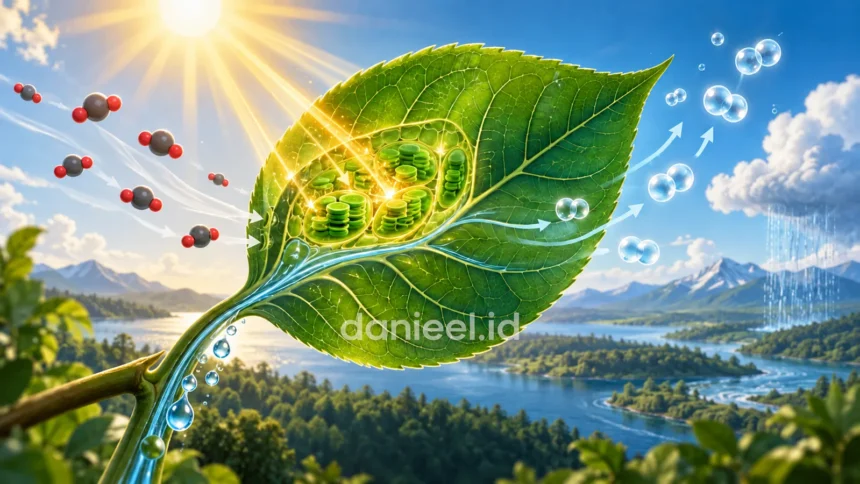
Let’s pause for a moment to reflect on one of the signs of Allah’s power as the Creator: the photosynthesis process. We learned about it at school, perhaps memorized the equation for an exam, and gradually forgot it. Yet behind the leaves we walk past every day, something remarkable is happening that helps feed life and provides the oxygen it needs.
I’d like to invite us to take another, closer look. We don’t need to memorize every term. Just follow how sunlight can end up as rice on our plates, fruit on the table, and energy for our daily activities. When you think about it, isn’t that amazing?
The Photosynthesis Process: Harvesting Light for Life
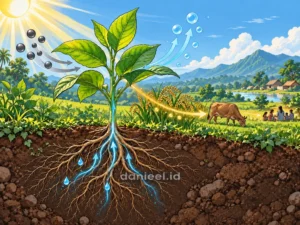
Put simply, photosynthesis is how plants, algae, and certain bacteria use light to make organic matter. In plants, this work mainly takes place in chloroplasts, small structures inside cells that contain chlorophyll.
Here’s the equation we might still remember:
6 CO2 + 6 H2O + light energy → C6H12O6 + 6 O2
In other words, water and carbon dioxide, with energy from light, are used to produce sugar and release oxygen. This equation sums up the outcome; inside a leaf, it takes many steps.
First, light energy is used to make ATP and NADPH, energy carriers we can think of as supplies for the next stage. Water is split and oxygen is released at this stage. So the oxygen produced comes from water, rather than CO2.
Those supplies are then used in the Calvin cycle to turn carbon from CO2 into the building blocks of sugars. This gives plants material for growth and a way to store energy.
We can see photosynthesis as a process created by God to provide food and oxygen for life. When we eat rice, vegetables, fruit, or animals that feed on plants, we use solar energy that living organisms have already transformed.
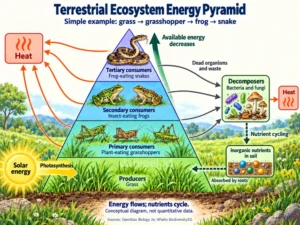
Look at the energy pyramid above. Grass forms the base as a producer. Its energy passes to grasshoppers, frogs, and snakes as one organism eats another. Less energy is available at each higher level because some has been used for life’s activities and released as heat. That is why the pyramid narrows toward the top.
Decomposers return nutrients from the remains of living things to the environment. Nutrients can cycle back, while energy flows through and eventually dissipates as heat. The illustration helps us see how the photosynthesis process supports life far beyond plants themselves.
Its connection with our breathing is fascinating too. Photosynthesis stores energy and releases oxygen; cellular respiration uses organic matter and oxygen to obtain energy, producing CO2 and water. Plants also carry out respiration, day and night. Staying in one place certainly doesn’t mean they aren’t busy.
Photosynthesis and the Right Light
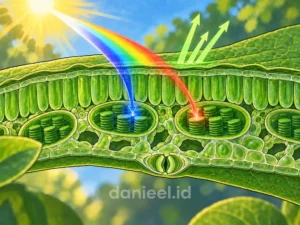
Sunlight looks white, but it contains many colors. Beyond visible light, there is radiation our eyes cannot detect. All of it belongs to the electromagnetic spectrum, from radio waves to gamma rays.
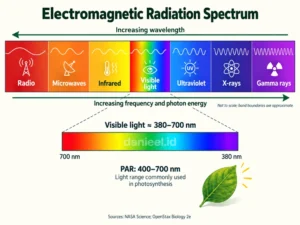
In the spectrum diagram above, visible light occupies only a small part of that broad range. The range commonly called photosynthetically active radiation, or PAR, is about 400–700 nanometers. A nanometer is a very small unit of length. The diagram is schematic, so the spacing between its sections is not to scale.
As NASA’s explanation of visible light describes, each color has a different wavelength. Chlorophyll mainly absorbs blue and red light, while more green light is reflected or transmitted. The light reaching our eyes makes leaves look green.
That doesn’t mean green light is entirely useless. Plants have other pigments, including carotenoids, that help capture light and protect the system from excess energy. Pigments, proteins, and leaf structures work together.
I picture it as a receiver that needs to match its signal. Of course, a leaf is far more complex than any receiver we build. But this simple analogy helps us see that the photosynthesis process depends on a match between incoming light and the system receiving it.
Knowing how it works only adds to my sense of wonder. Something as apparently simple as a green leaf contains such carefully coordinated activity.
Leaves Aren’t Life’s Only Factories

When we hear about photosynthesis, we usually picture trees. But the oceans contain phytoplankton, tiny organisms that photosynthesize and form the base of many marine food webs. They may be small, but their role is enormous.
NOAA explains that roughly half of Earth’s oxygen production comes from the ocean, mainly from photosynthetic plankton. Much of that oxygen is also consumed by marine life. That production figure does not mean half the oxygen we breathe has just been made in the sea.
Interesting, isn’t it? Standing on a beach, we might see only water and waves. Beneath the surface, quiet work is helping sustain life on this planet.
On land and at sea, the photosynthesis process is affected by light, water, temperature, CO2, and nutrients. Protecting forests and oceans therefore means protecting connected living systems, as well as beautiful scenery.
Resilient and Adaptable, but Still in Need of Care
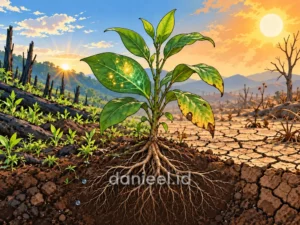
Have you seen grass turn green again after rain, even though it looked dry before? Plants have various ways of coping with their surroundings. Some adjust their growth; others regulate gas exchange to avoid losing too much water.
In CAM plants, such as many cacti, pores called stomata open at night to take in CO2. During the day, that stored supply is used with energy from light. This helps conserve water in dry environments.
Resilience does not make plants immune to damage. DNA can be damaged, cells need to repair it, and different plants have different capacities to survive. Extreme drought, repeated fires, or habitat loss can still overwhelm them.
For me, understanding what plants can do gives us even more reason to care for them. We shouldn’t assume nature will always recover on its own and feel free to damage it.
What Can We Learn from a Single Leaf?

Once we understand the photosynthesis process, we may see food and plants differently. Rice doesn’t simply appear on our plates. Light, water, air, soil, and living things are all connected before it reaches us.
This connection also reminds me of the lessons learned from the fall and rise of world civilization: human life depends on many things we often overlook. Our bodies, which benefit from all this, deserve care too, as I discuss in 18 tips for a healthy and fit life.
Wonder can begin with simple things and lead to simple actions. Caring for a tree in the yard, choosing plants suited to local conditions, and wasting less food are ways to appreciate life more fully.
Conclusion
The photosynthesis process turns light energy into chemical energy that supports most food webs, while producing oxygen in plants and other organisms that carry out oxygenic photosynthesis. We don’t have to understand every reaction to recognize how much it matters.
For me, this order is one of the signs of Allah’s greatness. Subhanallah—glory be to Allah, Creator of the heavens, the Earth, and everything within them. Let us reflect on His creation, as Allah says in Surah Ali ‘Imran, verses 190–191:
“Indeed, in the creation of the heavens and the earth, and the alternation of night and day, there are signs for people of understanding: those who remember Allah while standing, sitting, or lying down, and reflect on the creation of the heavens and the earth, saying, ‘Our Lord, You have not created this in vain. Glory be to You, so protect us from the punishment of the Fire.’” (Qur’an, Ali ‘Imran 3:190–191; English rendering of the meaning)
Every now and then, pause as you walk past a tree. Look at its leaves. Quietly, without asking for attention, they are turning light into fuel for life. Something we see so often turns out to be anything but ordinary.
Frequently Asked Questions about Photosynthesis
Does photosynthesis only happen during the day?
The light reactions need light. Calling the Calvin cycle the “dark reactions” does not mean it happens only at night; this stage uses ATP and NADPH from the light reactions.
Does all oxygen come from trees?
No. Algae, phytoplankton, and other photosynthetic organisms also produce oxygen. Atmospheric oxygen reflects accumulation and the balance of various processes over a long time.
This post is also available in: