








Two profitability indicators with different purposes and how to read them together.
The difference between EBITDA and net profit often feels confusing because both are used to discuss a company’s earnings. EBITDA helps us see operating results before interest, taxes, depreciation, and amortization are accounted for. Net profit shows the final earnings after all these elements are included in the calculation.
Therefore, they are not interchangeable. EBITDA is useful for highlighting operational capability, while net profit shows the remaining earnings for the company after all expenses.
To make it easier to understand, I’ll use an example income statement from an imaginary company, danieel.id/ (which I previously wrote about in the article: Understanding the 4 Types of Company Financial Statements)
Example of an imaginary company’s income statement
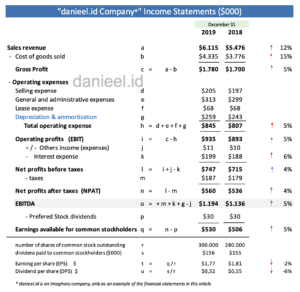
From this income statement, 2019 sales reached $6,115, up 12% from $5,476 in 2018. However, the cost of goods sold increased faster, by 15%, from $3,776 to $4,335. As a result, gross profit only increased by 5%, from $1,700 to $1,780. This reminds us that an increase in sales does not necessarily lead to a proportional increase in margin.
Total operating expenses increased from $807 to $845. After being deducted from gross profit, operating profit or EBIT increased from $893 to $935. The company also recorded other income of $11 and interest expense of $199. Net profit before taxes became $747, and after taxes of $187, net profit after taxes was recorded at $560.
In 2018, net profit after taxes was $536. Thus, net profit increased by approximately 4%. EBITDA in the report increased from $1,136 to $1,194, or about 5%.
How to calculate EBITDA from the example
EBITDA stands for earnings before interest, taxes, depreciation, and amortization.
For the 2019 example, the most direct way is to add back depreciation and amortization to operating profit:
EBITDA = Operating profit + Depreciation & amortization
EBITDA = $935 + $259 = $1,194
We can also start from net profit after taxes, but other income must be considered for consistent reconciliation:
EBITDA = Net profit + Taxes + Interest + Depreciation & amortization − Other income
EBITDA = $560 + $187 + $199 + $259 − $11 = $1,194
For 2018, the calculation is $893 + $243 = $1,136.
Why are depreciation and amortization added back?
Depreciation is the allocation of the cost of tangible assets over their useful life, while amortization applies a similar concept to intangible assets. Both are expenses that reduce profit, but they are not cash payments to other parties during the recording period.
That’s why depreciation and amortization are added back when calculating EBITDA. However, this does not mean these costs can be ignored. Machinery, vehicles, equipment, and other assets still decline in value and will eventually need repair or replacement. High EBITDA does not automatically mean low capital expenditure requirements.
Key differences between EBITDA and net profit
| Aspect | EBITDA | Net profit |
|---|---|---|
| What it measures | Performance before interest, taxes, depreciation, and amortization | Final profit after all revenues and expenses |
| Interest and taxes | Added back | Already accounted for |
| Depreciation and amortization | Added back | Reduces profit |
| Primary use | Comparing operational capability | Assessing final profit and EPS basis |
Practically, the difference between EBITDA and net profit lies in how far down the income statement we go. EBITDA stops before several key components are factored in, while net profit is at the very end. Therefore, the difference between the two can provide insight into the burden of a company’s interest, taxes, depreciation, and amortization.
When is EBITDA useful?
EBITDA is helpful when we want to compare the operational capabilities of several companies in the same industry, especially when their debt structures, tax rates, or asset ages differ. In the danieel.id/ Company example, EBITDA grew by 5%, slightly faster than net profit, which grew by 4%. This indicates that performance before interest, taxes, depreciation, and amortization improved slightly faster than the final profit.
But EBITDA is not cash flow. This figure does not account for changes in working capital, interest and tax payments, or capital expenditures. Therefore, I would not assess a company’s health based solely on EBITDA. Also read the company cash flow statement to see how much cash is actually generated.
In the context of reporting, the calculation method also needs to be clearly explained. The SEC guidance on non-GAAP measures states that EBITDA needs to be reconciled to net income. IFRS 18 on management-defined performance measures also emphasizes the importance of explanation so that readers understand the measures used by the company.
When is net profit more relevant?
Net profit shows the result after all expenses have been accounted for. This figure is an important basis for calculating earnings per share (EPS), assessing potential dividend distributions, and determining retained earnings. In the screenshot, the 2019 net profit after taxes of $560 minus preferred stock dividends of $30 results in earnings available for common stockholders of $530.
With 300,000 common shares outstanding, EPS is shown as $1.77. Dividends for common shareholders totaled $156, so dividend per share was recorded at $0.52. Here, it is clear that net profit is more closely related to shareholder interests, although net profit is also not the same as cash.
Don’t choose just one
A company with high EBITDA does not necessarily have strong net profit or cash flow if its interest expenses, taxes, working capital needs, and capital expenditures are high. Conversely, a single year’s net profit can be affected by non-recurring non-operating income or expenses.
I prefer to read both together: EBITDA to see the operational engine, net profit to see the final result, and then cash flow to ensure that the profit is truly supported by cash. The assessment becomes more complete when combined with EBITDA margin, net profit margin, ROA, ROE, and multi-year trends. You can also see the relationship between these figures in the articles how to read an income statement and company financial ratios.
Conclusion
In conclusion, the difference between EBITDA and net profit is not about which is always better. They answer different questions. In the example of the imaginary company danieel.id/, 2019 EBITDA is $1,194 and net profit after taxes is $560. Use the first figure to understand the capability before certain components, then use the second figure to see the profit after all expenses. After that, check the cash flow statement so that the picture of the company’s condition doesn’t stop at paper profits.
This post is also available in: