







Losing 22 pounds in six months sounds like a tough goal. But spread it out evenly and it comes to only about 0.9 lb (400 grams) a week, less than a 1-lb bag of sugar (and sugar, as it turned out, was one of the “suspects”, hehe). That small weekly number is what helped me lose 22 lbs in 6 months, going from 192 lbs (87 kg) in October 2016 to 170 lbs (77 kg) by the end of March 2017, after years of failing at one diet program after another.
The key turned out to be not a popular diet, but a moderate energy deficit (taking in slightly less energy than the body uses) kept up consistently through everyday habits. I deliberately didn’t commit to the Mayo diet, keto, or OCD (Obsessive Corbuzier’s Diet, an intermittent-fasting method popular in Indonesia), and chose an approach that made sense and that I could actually keep doing.
Think of it as your body having a daily energy budget, much like a household budget. Food is income, activity is spending, and body fat is the savings that pile up when income keeps running high. To draw those savings down, you only need to spend a little less than you earn every day, as long as you do it consistently.
To be fair, this is my personal experience, not a promise that everyone will get the same numbers. At roughly 0.9 lb a week, my pace was actually a little slower than the 1–2 lbs (0.5–1 kg) per week that the CDC’s guidance on losing weight describes as a rate that’s easier to maintain.
So what exactly did I do? There were ten simple habits that reinforced one another as I worked to lose 22 lbs in 6 months. Let’s start with what’s on the plate.
Gradually Reduce Rice Portions

Cut your rice portion, then fill the empty space with nutritious protein and vegetables.
Cutting my rice portions gradually, from half a plate down to a third, helped me keep total daily energy in check without treating rice as the enemy. It’s a classic tip, sure, but it still works.
At breakfast, my portion was still about half to two-thirds of a plate. Every now and then I swapped white rice for sweet potato, oats, whole-wheat bread, brown rice, or basmati rice. I filled the empty space with vegetables and protein such as tempeh, tofu, or fish (please don’t fill it with instant noodles instead).
The WHO’s healthy diet guidance still keeps carbohydrates on the daily menu, mainly from whole grains, vegetables, fruit, and legumes. So what you manage is the portion and the quality, not getting rid of rice altogether.
Read also :
Health Benefits of Fasting: Ramadan, IF and Autophagy
Eat Dinner Earlier and Smaller

I still ate dinner, but earlier and with a smaller portion.
Eating dinner earlier and in a smaller portion helped me break my late-night snacking habit, even though meal timing on its own is not a magic switch for weight loss. Having learned from past failures, I didn’t skip dinner.
I ate shortly before maghrib (the sunset prayer), with a smaller portion than lunch. The principle is a lot like this old saying:
“Eat breakfast like a king, lunch like a prince and dinner like a pauper.“
For me, the benefit was indirect: the kitchen “closed” earlier, so the temptation to snack at night shrank too. If I was still hungry, I chose fruit or a handful of nuts (a handful, not the whole jar).
Choose Low-Calorie, High-Fiber Foods
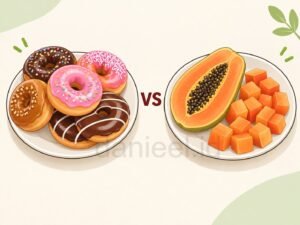
Which one would you pick? A doughnut or papaya?
Low-calorie, high-fiber foods such as vegetables and fruit keep your plate full and your stomach satisfied for longer without sending your energy intake through the roof. Gram for gram, a doughnut can carry several times the calories of papaya.
Fiber is also more than a “broom that sweeps things out”. It helps you feel full and supports digestive health. The WHO guideline on carbohydrate intake (2023) recommends that adults eat at least 400 grams of vegetables and fruit a day and at least 25 grams of naturally occurring dietary fiber from food.
At home, I keep healthy options within easy reach; I’ve written about some of them in the article 10 superfoods that are easy to prepare at home.
Reduce Added Sugar

Say no to sugar, especially added sugar in drinks.
Cutting back on added sugar, especially from sweet drinks, is one of the easiest ways to trim calories that don’t actually fill you up. I limited cakes, sweet martabak (a thick Indonesian pancake), candy, bottled tea, and soda.
I ordered my juices without sugar. Sour? Sure, but over time my taste buds got used to it. I also used to replace two spoonfuls of sugar in my coffee with one spoonful of honey. One thing needs setting straight, though: honey still counts as free sugar, so it still needs to be limited.
The WHO guideline on sugars intake recommends keeping free sugars below 10 percent of daily energy, and ideally below 5 percent. On a diet of about 2,000 kcal, the 10 percent limit works out to roughly 50 grams, or 12 teaspoons, of sugar, while 5 percent is only about 6 teaspoons. A few sweet drinks can use up that allowance fast.
Stop Mindless Snacking

The problem often isn’t hunger, but the habit of mindless snacking.
Mindless snacking, for example while typing or watching TV, often adds calories without really dealing with hunger. For me, it was my biggest weak spot, especially when the options were chips or fried snacks.
One handful of chips usually led to a second and a third, and before I knew it, half the jar was gone. Fried snacks were the same: one piece with a bird’s eye chili was often followed by another piece “to cool down the heat”, hehe.
So I stuck to three meals a day and stopped snacking whenever my attention was elsewhere. When I was genuinely hungry, I chose fruit, unsweetened yogurt, or a few nuts. The key is telling physical hunger apart from plain boredom.
Be Active for at Least 5,000 Steps a Day

A 5,000-step target was a realistic starting point for me.
A target of at least 5,000 steps a day was a realistic way for me to increase the energy my body used, because the steps could be collected through ordinary activities. The hardest part wasn’t the walking, but beating my own laziness.
Pulling up the blanket certainly feels more comfortable than heading out early in the morning. Strangely enough, once I got used to it, my body seemed to “ask” to move whenever I’d been sitting too long. At the airport, I used to go straight for the comfiest chair and snack on chocolate. Now I walk around for about 20 minutes first, no snacking, of course.
Read also: Walking After a Meal: Benefits, Timing, and Safety
5,000 isn’t a magic number; what matters is moving more than you did before. According to the CDC’s explanation of physical activity and weight, physical activity combined with managing what you eat creates the deficit that supports weight loss.
Exercise for 30 Minutes Regularly

Exercise doesn’t have to be complicated; what matters is doing it regularly and within your ability.
Exercising for 30 minutes regularly, at least three times a week, helped me maintain my energy deficit and improve my fitness, as long as the activity matched my ability and was easy to fit in. For office workers, finding the time is a challenge of its own.
Even in a big city like Jakarta there are options, such as cycling to work or using a treadmill at home. At the time I lived in a smaller city, so my choices were simple: a morning walk of about 3 miles (5 km) before work, cycling once a week, group exercise on Friday mornings, and the occasional game of badminton.
For me, routine matters far more than a burst of enthusiasm that lasts three days. The WHO physical activity recommendations call for at least 150 minutes of moderate-intensity aerobic activity a week, plus muscle-strengthening exercise on two days a week. My starting target of 3 × 30 minutes was only about 60 percent of that, so it made sense to build up gradually.
Read also: Strength Training After 30: 10 Major Benefits
Get Enough Sleep, Around Seven Hours

Getting enough sleep helped me keep my energy up and my hunger in check.
Getting enough sleep, around seven hours, helps keep appetite and energy regulated, so your food decisions the next day are easier to control. The point isn’t that fat only “burns while you sleep”, but that short sleep can throw off hunger, mood, and the energy you need to stay active.
In a randomized clinical trial by Tasali and colleagues (2022) in JAMA Internal Medicine, 80 young adults with overweight who usually slept less than 6.5 hours received sleep counseling. Their sleep increased by about 1.2 hours a night, and their energy intake dropped by an average of about 270 kcal a day compared with the control group.
The study was short and limited to people who weren’t getting enough sleep, so the results may not apply to everyone. While working to lose 22 lbs in 6 months, I aimed for at least about seven hours of sleep, and the pull toward sweets when I was tired felt much weaker.
Use a Scale and a Measuring Tape
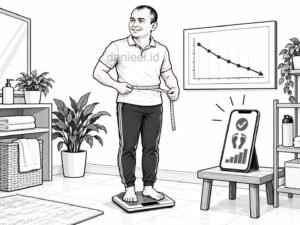
A scale and a measuring tape help you track progress objectively, and they’re most useful when the results are used to adjust your habits. I used simple tools: a bathroom scale for my weight, a tailor’s tape for my waistline, and a phone app to count my steps.
The data added motivation and doubled as an alarm: when the scale started going the wrong way or my daily steps were stuck at a thousand, some habit needed fixing. Because body weight goes up and down with fluids and digestion, I watched the trend over several weeks, not a single number.
A systematic review and meta-analysis by Madigan and colleagues (2015) found that weighing yourself alone, without any other program, has not been shown to be effective. The benefit appears when self-weighing is part of a behavior-change program, especially one with accountability, such as reporting your results to someone else.
Motivate Each Other with Friends or Family

Support from friends or family makes changes to eating and exercise easier to sustain, because it brings a sense of responsibility, a place to share struggles, and a reason to get back on track after slipping.
A well-meant snack offer from a friend or a dinner invitation can easily derail your plans. That’s why I invited my wife and close family to hold a kind of weight-loss competition. The goal wasn’t to embarrass anyone, but to remind one another. This is in line with a systematic review of social support-based weight-loss interventions. In practice, choose friends who are supportive, not ones who turn your weight into a joke.
Discipline and Consistency Until It Becomes a Lifestyle
Discipline and consistency are the most important factors tying these ten habits together, because the real challenge is keeping the weight off once you’ve reached your goal. I didn’t want to serve a six-month “sentence”; I wanted to build habits that would keep going. Here’s a summary of what helped me lose 22 lbs in 6 months:
| Habit | What I did | Why it helps |
|---|---|---|
| Rice portions | Half, then a third of a plate | Keeps total energy in check |
| Dinner | Earlier, smaller portion | Stops late-night snacking |
| Fiber | Vegetables, fruit, whole foods | Keeps you full longer |
| Added sugar | Unsweetened drinks | Cuts “invisible” calories |
| Snacks | No snacking while multitasking | Prevents autopilot eating |
| Daily steps | At least 5,000 steps | Uses more energy |
| Exercise | 30 minutes, 3 times a week | Deficit and fitness |
| Sleep | Around seven hours | Steadier appetite |
| Tracking | Scale, tape, app | Early warning when off track |
| Support | Family competition | Motivation and accountability |
I’ve written about the tug-of-war between short-term pleasure and long-term benefits in an article, Marshmallow Test: 7 Important Lessons on Self-Control. The pattern is the same: small decisions repeated over time matter more than one big action.
The results were worth it: a lighter body, better fitness, and choosing clothes became a lot more fun. There were a few other “pleasant side effects” too (let’s keep those my little secret).
“Yes, I am trying to eat healthy. No, I am not on a diet. I am changing my lifestyle.“
A Few Questions from Readers
Is it safe to lose 22 lbs in 6 months?
For many healthy adults, a pace of about 0.9 lb a week counts as gradual, even slightly below the 1–2 lbs per week range mentioned by the CDC. However, if you have obesity or diabetes, are pregnant, or take regular medication, talk to a doctor or dietitian about your target first.
How many calories do I need to cut each day?
As a rough rule of thumb, 1 lb of body fat equals about 3,500 kcal, so losing about 0.9 lb a week requires a deficit of roughly 440 kcal a day, from a mix of eating less and moving more. This is only an estimate because the body adapts as weight goes down, so tracking the trend on your scale is often more practical than counting calories strictly.
Do I have to stop eating rice to lose weight?
You don’t have to give up rice to lose weight; what helps is controlling portions and improving the quality of your carbohydrates. For example, swap some white rice for brown rice, sweet potato, or oats, then fill the rest of the plate with vegetables and protein.
So, What’s the Key to Losing 22 lbs in 6 Months?
Back to that bag of sugar: losing about 0.9 lb a week may feel small, but after 26 weeks it adds up to 22 lbs. My success in managing to lose 22 lbs in 6 months didn’t come from one secret trick, but from a combination of controlled portions, fiber-rich foods, limited sugar and snacks, a more active body, enough sleep, regular tracking, and family support.
Just like a household budget, what draws down your fat savings isn’t one day of extreme saving, but a small gap kept up every day. My results may not be the same for someone else, so don’t force rapid weight loss just for a number on the scale.
The first step is simple: choose one small change today, such as swapping sweet tea for unsweetened tea. No need to wait for Monday; once the first habit feels easy, add the next one.
Of the ten habits above, which one do you think would be the hardest to stick with, and which is the most realistic to start this week? Share your experience below; it might encourage other readers.
That’s how my journey began: slowly, stumbling at times, but always moving forward.
Note: this article is for general education and is not a substitute for advice from a doctor or qualified health professional.
References
- Centers for Disease Control and Prevention (CDC). Losing Weight. https://www.cdc.gov/healthy-weight-growth/losing-weight/index.html
- World Health Organization (2023). Carbohydrate intake for adults and children: WHO guideline. https://www.who.int/publications/i/item/9789240073593
- Madigan, C. D., Daley, A. J., Lewis, A. L., Aveyard, P., & Jolly, K. (2015). Is self-weighing an effective tool for weight loss: a systematic literature review and meta-analysis. International Journal of Behavioral Nutrition and Physical Activity, 12, 104. https://doi.org/10.1186/s12966-015-0267-4
This post is also available in: