






Reading a statement of changes in equity isn’t actually as hard as it looks. We just need to follow the journey of the owner’s capital from the beginning balance to the ending balance: what increases it, what decreases it, and where each change comes from.
This report serves as a bridge between the income statement and the company’s balance sheet. Net income goes into retained earnings, dividends decrease it, while the issuance or repurchase of shares changes the paid-in capital. The ending balance then appears in the equity section of the balance sheet.
According to IAS 1 on the presentation of financial statements, the statement of changes in equity is one part of a complete set of financial statements. In Indonesia, the list of these financial statement components is also listed in PSAK 201.
How to Read a Statement of Changes in Equity from the Beginning Balance
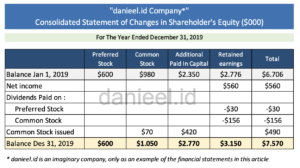
The first step is to look at the beginning balance of each equity component. In the example of the imaginary company danieel.id/ Company, all figures are presented in thousands of US dollars ($000). As of January 1, 2019, preferred stock totaled $600, common stock $980, additional paid-in capital $2,350, and retained earnings $2,776. The total beginning equity was $6,706.
Don’t look at the last row right away. By understanding the beginning balance, we have a point of comparison to assess whether changes during the current year come from the company’s performance or from transactions with owners.
Tracing Net Income and Dividends
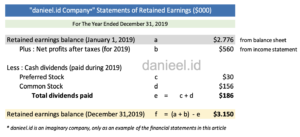
During 2019, the company recorded net income after tax of $560. This profit increases retained earnings. However, an increase in profit doesn’t mean cash increases by the same amount because the income statement uses the accrual basis. Cash movements need to be checked through the cash flow statement.
The company also paid preferred stock dividends of $30 and common stock dividends of $156. The total dividends of $186 reduce retained earnings. That’s why the $560 net income doesn’t all stay within the company.
The reconciliation is simple: ending retained earnings = beginning retained earnings + net income – dividends. In this example, $2,776 + $560 – $186 = $3,150. Small unit differences that might appear when calculating source values before rounding don’t need to be added to the table, as the Excel screenshot does display rounded numbers.
Reading Stock Issuances and Additional Capital
Besides profits and dividends, a complete report shows common stock issued. Common stock increased by $70, while additional paid-in capital increased by $420. Thus, the additional capital from stock issuance totaled $490.
Why is the increase in common stock only $70, not $490? Common stock is usually recorded based on its nominal value or par value. The portion of the issuance price that exceeds the nominal value goes into additional paid-in capital. Therefore, funds obtained from issuing new shares shouldn’t be assessed solely by the change in the common stock account.
In this example, preferred stock remains at $600. Common stock changed from $980 to $1,050, while additional paid-in capital changed from $2,350 to $2,770. The combination of net income, dividends, and stock issuance brought total equity from $6,706 to $7,570.
Understanding Retained Earnings Correcty
Retained earnings are often misunderstood as cash kept in a specific account. In reality, retained earnings are the accumulation of profits that haven’t been distributed to shareholders. Those funds might have already been used to buy inventory, machinery, buildings, or other assets.
That’s why retained earnings need to be read alongside the balance sheet and cash flow. The $3,150 balance explains the portion of equity coming from accumulated profits, but it doesn’t tell you where the money is. To see the relationship between all four reports as a whole, readers can go back to the explanation of the four types of corporate financial statements.
What Can Be Analyzed from Changes in Equity?
After understanding the basic numbers, the next step in how to read a statement of changes in equity is to ask the right questions:
- Does the equity growth primarily come from profits or from issuing new shares?
- What portion of the profit is distributed as dividends and how much is retained to support growth?
- Has the number of shares increased so that the ownership stake of old shareholders is potentially diluted?
- Are retained earnings increasing consistently year after year?
- Is the ending balance of each component the same as the equity figure on the balance sheet?
In the danieel.id/ Company example, the $864 increase in total equity comes from two main sources. First, net income after deducting dividends added $374 to retained earnings. Second, the stock issuance added $490 to capital. So, equity growth didn’t just come from business operations, but also from new capital contributions.
That interpretation is important. A company whose equity grows due to accumulated profits has a different story than a company that relies on issuing shares. Neither is automatically good or bad; we still need to understand the funding purpose, business prospects, and the impact on shareholders.
Conclusion
Ultimately, how to read a statement of changes in equity is to follow the reconciliation from beginning capital to ending capital. Profits increase equity, dividends decrease retained earnings, and stock issuances increase paid-in capital. In this example, equity increased from $6,706 to $7,570, with an ending retained earnings balance of $3,150.
Use this report as a connector, not as a standalone document. Match net income with the income statement, the ending balance with the balance sheet, and dividends and stock issuances with the financing cash flow. That way, we can understand not just that capital changed, but also the reasons for those changes.
More details on the 4 Types of Corporate Financial Statements, namely: Income Statements (Income Statements), Balance Sheets (Balance Sheets), Statements of Changes in Equity (Statement of Changes in Equity), and Cash Flow Statements (Cash Flow Statements), can be read in the article: Understanding the 4 Types of Corporate Financial Statements.
Source:
Lawrence J. Gitman & Chad J. Zutter, “Principles of Managerial Finance.” 13th Edition
This post is also available in: