






Looking at where cash comes from, where it is used, and why company profits aren’t always the same as cash.
How to read a cash flow statement begins with a very simple question: during a single period, where did the company’s money come from and where was it used? This question is important because a profit that looks good doesn’t necessarily mean the company’s cash is safe.
In accrual-based accounting, sales can be recognized when goods or services have been delivered, even if the customer hasn’t paid in cash yet. Expenses can also be recorded when the obligation arises, even if the payment is made later. Because of this, a company can post a profit but experience cash pressure at the same time.
The cash flow statement helps us bridge that gap. According to PSAK 207 regarding Cash Flow Statements, changes in cash and cash equivalents are classified based on operating, investing, and financing activities. The same breakdown is also explained in IAS 7 Statement of Cash Flows.
To simplify the discussion, we are using the report of an imaginary company, “danieel.id/ Company,” which operates in the manufacturing sector. All figures in the screenshot are stated in thousands of US dollars ($000). The figures in the review are written exactly as they appear in the screenshot, without adding decimal places.
How to Read a Cash Flow Statement and Its Relationship to Profit
In the indirect method, operating cash flow starts from net income, then is adjusted for non-cash transactions and changes in working capital accounts. This is why the net income figure is not immediately considered as cash entering the company’s account.
The easiest example is credit sales. When goods have been shipped, the company can record revenue and profit. However, before the customer pays, that value remains in the accounts receivable. An increase in receivables means part of the profit has not yet turned into cash.
The same applies to depreciation and amortization. Both of these expenses reduce profit on the income statement but do not cause a cash payment in the current period. Therefore, in the indirect method reconciliation, depreciation and amortization are added back.
To understand the source of profit used in this example, readers can refer to the article how to read a company’s income statement. Meanwhile, changes in receivables, inventory, payables, and fixed assets can be traced in the article how to read a company’s balance sheet.
Summary of danieel.id/ Company Cash Flow Statement Example
Here is an example of the Daniel.id/ Company Cash Flow Statement for the year ended December 31, 2019.
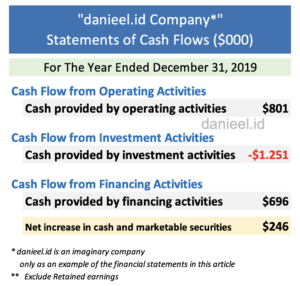
In summary, operating activities generated $801 in cash. Investing activities used $1,251 in cash, while financing activities generated $696 in cash. If the three are added together, the net increase in cash and marketable securities is $246.
$801 − $1,251 + $696 = $246
This simple equation serves as the first check when performing a how to read a cash flow statement: ensure the sum of the three activity groups equals the net increase or decrease in cash.
Cash Flow from Operating Activities
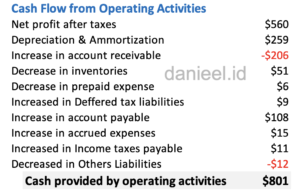
Operating activities describe the cash generated or used by the company’s core business. In this example, the calculation starts from a net income after tax of $560. Depreciation and amortization of $259 are added back because both are non-cash expenses.
After that, profit is adjusted for changes in working capital. Accounts receivable increased by $206, so it is recorded as a cash outflow. This means the company has recognized the sale, but that additional amount of money has not yet been received from the customer. Conversely, inventory decreased by $51 and prepaid expenses decreased by $6. These decreases release cash that was previously tied up in current assets.
On the liability side, accounts payable increased by $108, accrued expenses increased by $15, and income tax payable increased by $11. These increases in liabilities temporarily add to cash because payments have not been made in full. Deferred tax liabilities increased by $9, while other liabilities decreased by $12.
After all adjustments, operating activities generated a positive cash flow of $801. This figure is larger than the net income of $560. Generally, this indicates that the company’s profit for that year was truly supported by operating cash flow. However, we still need to note that part of the cash was helped by an increase in accounts payable. The quality of cash flow should be assessed over several periods, not just one year.
Cash Flow from Investment Activities
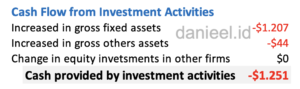
Investing activities relate to the purchase and sale of long-term assets and other investments that are not cash equivalents. In the danieel.id/ Company example, gross fixed assets increased by $1,207 and other gross assets increased by $44. Both additions resulted in a total cash outflow of $1,251.
Negative investing cash flow does not automatically mean the company is in trouble. Here, the largest part relates to the addition of fixed assets. From the balance sheet, we know that the largest increase occurred in machinery. This gives an indication that the company is adding to or updating its production capacity.
The question to ask is whether the investment is productive. In the following period, we hope the new machinery helps increase production, efficiency, revenue, or profit. If investments continue to absorb cash but do not improve operating performance, then the reader needs to be more cautious.
Conversely, positive investing cash flow is also not always good news. A positive figure can appear because the company is selling assets. If what is sold are productive assets to cover short-term cash shortages, that condition could actually reduce the company’s ability to generate revenue in the future.
Cash Flow from Financing Activities
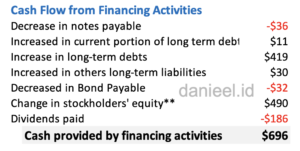
Financing activities show how a company obtains funds from creditors and shareholders, as well as how those funds are returned. This section helps answer whether investment needs are financed from operating cash, loans, stock issuance, or a combination of all.
In the example, notes payable decreased by $36 and bonds decreased by $32. Both changes used cash. On the other hand, the current portion of long-term debt increased by $11, long-term debt increased by $419, and other long-term liabilities increased by $30.
Changes in share capital—excluding retained earnings—provided an additional $490 in cash. The company also paid $186 in dividends to shareholders. After all components are added up, financing activities generated a net cash inflow of $696.
This figure shows that the $1,251 investment could not yet be fully financed by the $801 operating cash. The company covered that need through additional debt and share capital. This strategy can make sense if the new investment generates an adequate rate of return and the additional obligations can still be serviced by future cash flows.
Reading the Three Activities as One Story
The most important part of how to read a cash flow statement is connecting the three activities, not assessing each one separately. In this example, operating activities generate cash. The company then spends a larger amount of cash for investment. The shortfall is covered by external financing.
That pattern fits the story on the balance sheet: the company buys fixed assets, especially machinery, while adding long-term debt and share capital. At the end of the period, cash and marketable securities still increased by $246. This figure can be reconciled with the balance sheet, namely the increase in cash from $611 to $841 or $230, plus the increase in marketable securities from $105 to $121 or $16.
In other words, the income statement shows that the company generates a profit, the balance sheet shows changes in asset positions and their sources of funding, while the cash flow statement explains the movement of money that connects the two. The statement of changes in equity then explains changes in capital and retained earnings. This relationship is discussed more fully in the article on the four types of company financial statements and how to read a statement of changes in equity.
Conclusion
How to read a cash flow statement can be summarized into three steps: check cash from operations, understand the purpose of investment flows, then look at the source and use of funds in financing activities. After that, match the net increase in cash with the balance sheet.
In the danieel.id/ Company example, positive operating cash flow serves as the foundation. The company uses it for asset investment, then adds debt and share capital to cover the larger need. The final result is a cash increase of $246. This is not a final investment assessment, but an example of how cash flow figures can be read as a single business story.
The phrase “cash is king” does have some truth to it, but hoarding too much cash is also not always efficient. A company needs to maintain liquidity while using cash productively to create value in the future.
Common Questions
Why is net income different from operating cash flow?
Because profit is calculated on an accrual basis. Operating cash flow adjusts profit for non-cash transactions as well as changes in accounts receivable, inventory, accounts payable, and other working capital accounts.
Is negative investing cash flow always bad?
No. A negative flow can indicate the company is buying productive assets. The assessment depends on the purpose of the investment and the results provided in the following period.
What should be checked after reading a cash flow statement?
Compare operating cash flow with net income, trace investments on the balance sheet, check changes in debt and equity, and then look at consistency over several periods.
More details regarding the 4 Types of Company Financial Statements, namely: Income Statements (Income Statements), Balance Sheets (Balance Sheets), Statements of Changes in Capital (Statement of Changes in Equity), and Cash Flow Statements (Cash Flow Statements) can be read in the article: Understanding the 4 Types of Company Financial Statements.
Source:
Lawrence J Gitman & Chad J.Zutter, “Principles of Managerial Finance” 13th Edition
This post is also available in: