





If you’re considering an MBA while continuing to work, SMEMBA SBM ITB might be on your shortlist. This Strategic Marketing Executive MBA program is a collaboration between SBM ITB and the MarkPlus Institute. For me, that collaboration wasn’t just a fancy name on a brochure. I experienced it firsthand in the classroom.
I am an alumnus of SMEMBA Batch 3, from the 2019–2020 period. So, this post isn’t an objective ranking, nor is it a claim that one program is a perfect fit for everyone. This is a personal experience—a testimonial for my beloved alma mater and a keepsake of the wonderful times I had during my graduate studies.
Important note: The experiences I’m sharing took place from 2019 to early 2020, before the COVID-19 pandemic. Schedules, locations, faculty, curriculum, learning methods, fees, and admission requirements are subject to change. For the latest information, please check the official Strategic Marketing Executive MBA page. As of this update, the page describes an 18-month program with weekend classes and a minimum requirement of three years of work experience.
Now, with that little note out of the way, here are ten reasons why I chose SMEMBA SBM ITB for my MBA.
ITB’s Prestigious Reputation

Who doesn’t know ITB? The name Bandung Institute of Technology was certainly one of my considerations. Reputation isn’t the only reason to choose a campus, but let’s be honest: it gave me a sense of confidence when I was weighing where to continue my education.
SBM ITB itself was founded on December 31, 2003. Information about the school’s history, academic programs, and SBM’s position within ITB can be found in the official SBM ITB profile. I intentionally didn’t fixate on specific ranking numbers because rankings change from year to year. For me, what mattered more was the academic ecosystem, the quality of learning, and the experience I actually felt.
As part of ITB, SBM brings both academic standards and a massive network. That was the first door that made me look at this program more seriously.
A Great Collaboration Between SBM ITB and MarkPlus Institute
The Strategic Marketing Executive MBA program is a partnership between SBM ITB and the MarkPlus Institute. In my experience, it’s the perfect blend: business concepts and theories from academics meet real-world application from practitioners.
That collaboration also opens up opportunities to attend various marketing events, discussion forums, and alumni activities. I still occasionally receive invitations as both a participant and a speaker for events held by SBM ITB or MarkPlus. For me, the benefits didn’t stop once the exams were over.
In terms of institutional quality, SBM ITB earned ABEST21 international accreditation in 2018 and AACSB in 2021. Its current status and review cycles can be checked on the SBM ITB Quality Assurance and Accreditation page. Accreditation doesn’t automatically guarantee that every student’s experience will be the same, but for me, it was a worthy indicator to consider.
Engaging Teaching Methods That Encourage Active Participation
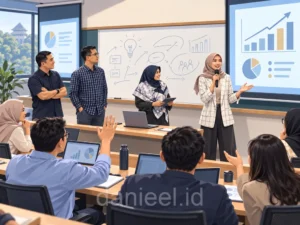
During my time, executive classes were held on weekends. The study sessions were long, from morning until evening. If it had just been one-way lectures, well, it could have turned into a festival of fighting off sleep.
Fortunately, the teaching methods encouraged students to be active—asking questions, answering them, dissecting case studies, engaging in group discussions, and giving presentations. Participation was also part of the grading in my class. As a result, we were motivated to come prepared—engaging with substance, not just talking just for the sake of it.
Well, at the very least, you’d read the theories and case studies before class so you wouldn’t look blank when the professor asked a question or be lost during discussions. 🙂
Don’t expect an A if you just sit there quietly, let alone try to sneak in a nap. At least, that was the atmosphere I experienced in Batch 3.
Current and Relevant Material

So, what do you study in SMEMBA? During my time, the scope was broad: marketing management, operations and supply chain, accounting, financial management, business economics, consumer behavior, business strategy, law and sustainability, brand communication, organization, and negotiation.
The current official course list may vary, so prospective students should compare my story with the latest SMEMBA program structure. What I loved at the time was how theory was brought together with real cases.
When studying accounting, for example, we discussed the financial statements of a state-owned enterprise that was currently in the news. While studying business strategy, we discussed the marketing strategies behind the booming Marvel movies. The material felt close to the professional world, not just a collection of definitions to be memorized.
My favorite was finance management. That course helped me understand financial statements, the time value of money, risk and return, capital budgeting, cost of capital, and valuation. For readers who want to dive deeper, I’ve previously written about the four types of corporate financial statements and various stock valuation methods.
“Man, where have I been all this time? I can’t believe I’m just learning this essential stuff now.”
That was literally what I muttered when the professor explained the link between financial theory and its real-world use. This doesn’t mean everyone will fall in love with the same course—this was just my personal favorite.
Expert Faculty: A Mix of Academics and Practitioners

The collaboration between SBM ITB and MarkPlus felt alive through its instructors. During my studies, we learned from both academics and experienced practitioners. I’ve intentionally left out their specific titles to keep the information current, as positions and faculty lineups can change.
What was most memorable was the combination. Academics helped us understand concepts systematically, while practitioners brought stories of how those concepts faced targets, constraints, organizational politics, and market realities.
In several courses, guest lecturers from the business world and government also appeared. For me, these sessions were fascinating because the theory we just learned was immediately tested against field experience. Sometimes the results reinforced the theory; other times, they made us realize that the real world is much more stubborn than the diagrams in a book.
Great Friends from Diverse Professional Backgrounds
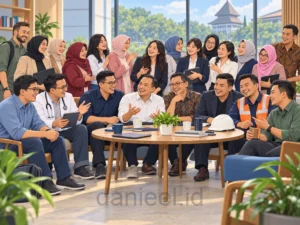
In my cohort, there were about 45 students with diverse work backgrounds: state-owned enterprises, banking, ministries, automotive companies, consumer goods, technology, and various other sectors. That diversity made discussions richer because a single issue could be viewed from many angles.
As it happened, my classmates were also fun and close-knit. We’d chat between classes, and sometimes head over to the mall next door—Kokas—after school. We even made class jackets and had a sort of family gathering before the pandemic. As of this update, the SMEMBA Batch 3 alumni group is still active.
However, this remains my cohort’s experience. Class camaraderie can’t be promised by a brochure or curriculum; it grows from the people who happen to meet and are willing to nurture those relationships.
Exciting Discussions

This was my favorite part of graduate school at SMEMBA. Challenging case studies, professors who were skilled facilitators, and diverse student backgrounds were the perfect recipe for creating heated—sometimes intense, but always cheerful—discussions.
We once debated why Nokia and BlackBerry, which once led the mobile market, were eventually pushed out. We also discussed ZARA’s procurement strategy: whether it’s better to cut costs by outsourcing production to lower-labor-cost countries, or to maintain a local, in-season, and vertically integrated production model.
In the People in Organization course, we dissected the Aditya Birla Group case. The debate touched on HR restructuring, hiring outside professionals for top management positions, redesigning performance management systems, and shifting the hierarchy from seniority to performance.
Man, I really miss that kind of exciting debate atmosphere. 🙂
English as the Language of Instruction

During my time, lectures, assignments, exams, group discussions, and the thesis were all in English. There were certainly challenges at first, especially when having to formulate spontaneous arguments in discussions. However, that was exactly where the real practice happened.
This program gave me the chance to brush up on my business English. In my cohort, there were even two international students, one from Italy and one from China. Their presence added a global flavor to the class.
I don’t want to say that using English automatically makes every graduate ready to compete internationally. Readiness still depends on individual ability and effort. However, for me, that learning environment provided a real space for practice.
Cool Classrooms
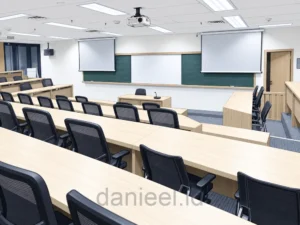
Comfortable classrooms are important, especially when you have to sit from morning to evening. In my time, classes were held in the Philip Kotler Theater on the 8th floor of the EightyEight@Kasablanka Building. The theater-style room had tiered seating, so we didn’t have to crane our necks to see the board or screen.
The multimedia and audio facilities also supported the learning process. For me, the room wasn’t the main reason to get an MBA, but it was definitely a nice little factor. If you have to spend your weekends in class, at least the class makes you feel at home.
It should be noted that this part is a memory from the 2019–2020 period. The official SBM ITB page now lists the Jakarta Campus MBA location at Graha Irama, Jalan H.R. Rasuna Said. Prospective students should check the latest class location before applying.
A Strong Alumni Network

ITB alumni are known for being tight-knit. As a graduate of SMEMBA SBM ITB, I also joined the ITB and MBA ITB alumni networks. In 2021, I participated in the election for the head of IA-ITB. That small experience made me feel connected to a community much larger than just my own class.
For me, the alumni network is an added value for expanding friendships, exchanging information, and opening up collaboration opportunities. However, a network isn’t a magic machine that instantly produces opportunities. You still have to show up, contribute, and build trust. An alumni card alone is certainly not enough.
If you’re still an undergraduate and want to start honing your organizational skills before taking a postgraduate program, my post on soft skills you can develop through student organizations might be a good companion read.
So, Is SMEMBA SBM ITB Right for You?
The ten reasons above explain why this program was a good fit for me: the ITB name, the collaboration with MarkPlus, active learning methods, relevant material, the mix of academics and practitioners, diverse classmates, exciting discussions, the use of English, comfortable classrooms, and the alumni network.
But choosing an MBA program remains a personal decision. Consider your career goals, interest in strategic marketing, weekend availability, financial capacity, family and office support, and your learning style. Don’t make a decision just because my ten reasons sound appealing—check the latest curriculum, schedule, fees, location, and requirements directly from the official source.
So, interested in joining SMEMBA SBM ITB? If you have questions about my experience or feedback on this post, please feel free to leave a comment. That’s all, hope this helps.
FAQ about SMEMBA SBM ITB
What is SMEMBA SBM ITB?
SMEMBA stands for Strategic Marketing Executive MBA, a Jakarta Campus MBA program from SBM ITB in collaboration with the MarkPlus Institute. Its latest focus and structure should always be checked on the official SBM ITB website.
Is SMEMBA suitable for working professionals?
This program is designed for executives, and official classes are scheduled for weekends. In my experience, this format allows for studying while working, although the reading load, assignments, discussions, and exams still require a serious time commitment.
How long is the SMEMBA program?
The official program page I checked when updating this article lists a duration of 18 months: three regular semesters and one short semester. This information is subject to change, so prospective students should check the latest admissions page.
Is everything in this article still the same now?
Not necessarily. My experience comes from Batch 3 in 2019–2020. Faculty, location, schedules, courses, teaching methods, fees, and admission policies can change. Therefore, this article should be read as an alumnus’s notes, not an official current brochure.
This post is also available in: