





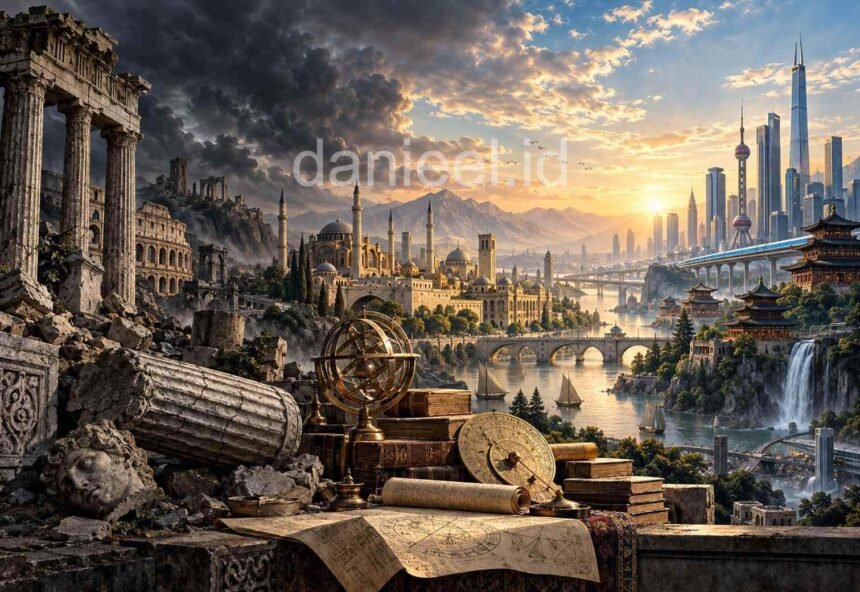
There are many lessons we can learn from world history. In the story of the rise and fall of world civilizations, we witness nations that once held vast empires eventually weaken, while those that were once lagging behind manage to catch up and even surpass their competitors.
Of course, history does not move like a wheel spinning in the exact same pattern. The words “civilization,” “progress,” and “decline” can mean different things to every era. However, by comparing several major events—the European Renaissance, the shifts in the Islamic world, colonialism, the Meiji Restoration, the collapse of the Soviet Union, the U.S. economic crisis, and the rise of China—we can still find patterns worth reflecting upon.
The European Renaissance

The European Middle Ages are often called the “Dark Ages.” While the term is popular, many historians consider it an oversimplification. Knowledge did not simply vanish: universities, scholastic philosophy, agricultural technology, architecture, and trade continued to flourish. The Renaissance itself emerged gradually, beginning primarily in Italian cities in the 14th century before spreading to other parts of Europe.
This movement revived interest in Greek and Roman texts, but it did not merely copy the past. The printing press, trade networks, city and court patronage, and the exchange of knowledge with the Islamic world all helped shape this intellectual shift. Figures like Leonardo da Vinci, Johannes Gutenberg, Francis Bacon, René Descartes, Johannes Kepler, and Galileo Galilei came from different generations and fields; they are more accurately placed within the continuum of the Renaissance and the Scientific Revolution rather than a single event.
The case of Galileo illustrates the complex relationship between science, authority, and religion. He supported Copernicus’s heliocentric model and in 1633 was declared “vehemently suspect of heresy” by the Inquisition. His sentence was served under house arrest. However, according to the Stanford Encyclopedia of Philosophy on Galileo, the case also involved legal procedures, patronage, papal politics, and debates over evidence—not just a simple battle between “science” and “religion.”
Advancements in navigation, cartography, metallurgy, gunpowder, and financial organization subsequently increased the ability of European nations to both trade and conquer. This is where the bright side of scientific development met the dark side of imperial expansion.
The Decline of Islamic Civilization
Starting in the 8th century, Baghdad under the Abbasid Dynasty became one of the most important centers for politics, trade, and science. Translators and scholars from Muslim, Christian, Jewish, Persian, Arab, and other backgrounds processed Greek, Indian, and Persian heritage. Bayt al-Hikmah (the House of Wisdom) is known as a symbol of translation and scholarly activity, though its popular depiction as a single giant “modern university” is still debated.
Names like Muhammad ibn Musa al-Khwarizmi in mathematics, al-Razi and Ibn Sina in medicine, Jabir ibn Hayyan in the alchemical tradition, al-Farghani in astronomy, al-Mas‘udi in history and geography, and al-Ghazali and Ibn Rushd in philosophy demonstrate the breadth of that intellectual tradition. Arabic works were later translated into Latin and helped shape the development of knowledge in Europe.
The Mongol invasion of Baghdad in 1258 was a major shock. The Crusades, political fragmentation, shifting trade routes, changes in patronage, epidemics, and economic pressure also played roles at various times and places. The Ottoman Empire itself lasted much longer: the sultanate was abolished in 1922, while the caliphate was only abolished by the Republic of Turkey in 1924.
It is important to qualify the word “decline.” The idea that “the gate of ijtihad was closed,” causing a decline in science, is a widely repeated interpretation rather than a single agreed-upon fact. Wael B. Hallaq’s study, Was the Gate of Ijtihad Closed?, shows that the claim of a total closure is debated. More recent research also emphasizes the diversity of scientific developments across many Islamic centers, meaning no single date or cause explains it all.
The lesson is not that any one religion or culture is destined to progress or decline. Scientific traditions require institutions, debate, openness, security, patronage, and networks capable of surviving across generations.
The Era of Colonialism
European ocean-faring capabilities grew alongside the search for trade routes, inter-state competition, the spread of religion, and the desire for wealth. The “Gold, Glory, Gospel” formula helps recall these motives, though the reality of each expedition was far more complex. Christopher Columbus reached the Caribbean in 1492, while Ferdinand Magellan’s expedition—completed by Juan Sebastián Elcano after Magellan’s death—conducted the first circumnavigation of the globe in 1519–1522.
I am still struck when reading about the conquests in the Americas. Hernán Cortés arrived in Mexico in 1519 with a Spanish force numbering only in the hundreds. Francisco Pizarro captured Atahualpa in Cajamarca in 1532 with fewer than two hundred soldiers. Exact troop numbers vary by source, so figures like 553 and 177 in older versions should not be treated as certainties.
More importantly, those victories were not the story of a few Europeans single-handedly conquering millions. Cortés gained the support of tens of thousands of indigenous allies who were hostile to Mexica/Aztec rule. The conquest of the Incas took place while the empire was ravaged by civil war, and Old World epidemics devastated populations and social orders. Cortés’s letters to the King of Spain are important primary sources, but because they were written to justify his actions, they must be read critically; the manuscripts are available at the Library of Congress.
The Industrial Revolution, which began in Britain in the second half of the 18th century, increased production, raw material needs, transportation capabilities, and military power. Its link to imperialism is strong, but the steam engine was not the creation of one person in a single step: James Watt refined earlier designs and made them far more efficient.
The British Empire subsequently became the largest empire in history. However, the modern Commonwealth is not a remnant of colonies all led by the British monarch; it is a voluntary association with diverse forms of member governments.
How were small European nations able to control such vast territories? The answer is not technology alone, but also trading companies, capital, bureaucracy, treaties, divide-and-rule politics, local allies, and violence.
The phrase “the Dutch colonized Indonesia for 350 years” is also a popular national oversimplification. The VOC was established in 1602, but Dutch control over the archipelago was built gradually and was never uniform. Many regions were only conquered in the 19th or early 20th centuries. This does not downplay colonization; rather, it allows us to see how dominance was built piece by piece, alongside constant resistance.
Japan’s Meiji Restoration

Japan during the Tokugawa era was not a completely closed country. The sakoku policy restricted foreign relations, but trade and knowledge still entered through specific channels, including Dejima in Nagasaki. The arrival of Commodore Matthew C. Perry’s fleet in 1853 increased pressure on Japan to open its ports. The Treaty of Kanagawa was signed in 1854.
The Meiji Restoration centered on the 1868 power shift following the turmoil at the end of the Edo period. The new government abolished feudal domains, established prefectures, formed a national military, reformed taxes, sent the Iwakura Mission abroad, and studied Western institutions. According to the National Diet Library of Japan, the Charter Oath of 1868 promised public deliberation and the search for knowledge from all over the world.
Education became one of the engines of change. The 1872 national school system adopted and adapted various foreign models—not just the German one—and was continuously revised. The government sent students abroad and invited foreign experts. This modernization was rapid but not without cost: heavy taxes, samurai rebellions, state discipline, and later Japanese imperialism were also part of its history.
Fukuzawa Yukichi, through Gakumon no Susume (An Encouragement of Learning), emphasized education and individual independence. His portrait has indeed graced the 10,000 yen note since 1984, but in July 2024, that design was replaced with a portrait of Shibusawa Eiichi. This small detail reminds us that even national symbols change.
After losing World War II, Japan rose again through a combination of institutional reform, education, investment, industry, market access, and the geopolitical context of the Cold War. For readers wanting to connect these historical lessons to modern education, the article on skills students hone through organizations provides an example on a personal scale.
The Collapse of the Soviet Union

The Russian Revolution toppled the Tsarist monarchy in 1917, but the Union of Soviet Socialist Republics (USSR/Soviet Union) was only officially formed in December 1922. After World War II, the Soviet Union became a superpower and the primary rival to the United States in the Cold War.
Its economy successfully achieved rapid industrialization and built a massive military force and space program. However, in its final decades, productivity slowed, civilian innovation lagged, the bureaucracy became rigid, and shortages of consumer goods eroded public trust. The military burden and the war in Afghanistan added pressure, though historians differ on the weight of each factor.
Mikhail Gorbachev—a figure easily remembered by viewers of the news program “Dunia dalam Berita” for the birthmark on his head—introduced glasnost (openness) and perestroika (restructuring). These reforms opened space for criticism but also exposed long-standing problems and accelerated nationalist dynamics in the Soviet republics. He was not the sole cause of the collapse.
A hardline coup in August 1991 failed and weakened Gorbachev’s position. Russia, Ukraine, and Belarus then declared that the Soviet Union no longer existed and formed the Commonwealth of Independent States. On December 25, 1991, Gorbachev resigned; a brief chronology can be read at the Office of the Historian, U.S. Department of State.
The Soviet Union did not collapse due to a direct enemy invasion. However, saying the cause was solely economic is also too narrow. A crisis of legitimacy, center-republic conflicts, political reforms, nationalism, the failed coup, and elite decisions were all decisive factors.
The Decline of the United States Economy

The financial crisis of 2007–2009 shook the United States and the world. Risky mortgages, rising home prices, complex securitization, high leverage, weak risk assessment, and regulatory failures reinforced one another. Lehman Brothers—an investment bank—went bankrupt on September 15, 2008. AIG was bailed out, Washington Mutual was closed by regulators and its banking assets sold, while Fannie Mae and Freddie Mac were placed into government conservatorship. Thus, these institutions were not all “collapsed investment banks.”
Federal Reserve History notes that the subprime crisis grew alongside credit expansion and rising home prices, then reversed when defaults increased and home prices fell. Unemployment spiked and the recession spread. At the same time, manufacturing competition with China and other nations increased pressure on several U.S. industrial communities.
Government debt and trade deficits are indeed risks worth monitoring, but the debt ratio must distinguish between gross debt and debt held by the public. Quantitative easing is also more accurately understood as the purchase of assets by the central bank to lower long-term interest rates and support markets, rather than simply “printing dollars” in a literal sense.
An older version of this article cited the film scenario The Day the Dollar Died and predicted the collapse of the dollar if China or OPEC nations abandoned it. That was a speculative prediction, not a historical fact, and it did not happen. The 2008 crisis showed America’s vulnerabilities, but it also showed the country’s capacity for policy response and recovery. Therefore, the title of this section should be read as a thesis on relative decline, not a verdict that collapse is certain.
The Barack Obama administration canceled the Constellation program in 2010, including the plan to return to the Moon in its then-current form. However, America did not stop spaceflight: NASA subsequently developed new approaches, including commercial crew partnerships and the Artemis program. To understand the economic health of a company without getting stuck on a single number, readers can also look at the guide to the four types of financial statements and financial ratios for performance analysis.
The Rise of China

After the death of Mao Zedong in 1976, China entered a period of change. In 1978, under the influence of Deng Xiaoping, the Communist Party affirmed the Four Modernizations—agriculture, industry, science and technology, and defense—and began the policy of reform and opening up. The idea of the Four Modernizations had actually been proposed by Zhou Enlai earlier; Deng made it an effective framework for reform.
Reforms took place gradually: the household responsibility system in rural areas, special economic zones, foreign investment, limited decentralization, and the expansion of market mechanisms. Jiang Zemin and Zhu Rongji continued the transformation, including the restructuring of state-owned enterprises and the process toward World Trade Organization membership in 2001.
The combination of one-party rule with market mechanisms produced extraordinary growth, but political stability is not the only explanation. Investment, education, infrastructure, urbanization, global trade, labor, productivity gains, and industrial policy all played a role. The World Bank notes that since 1978, China’s GDP growth has averaged over 9 percent per year and nearly 800 million people have escaped extreme poverty. At the same time, inequality, environmental pressure, debt, demographics, labor rights, and political restrictions remain real issues.
Zhu Rongji’s quote about “one hundred coffins”—99 for corrupt officials and one for himself—is very popular, but primary sources that can verify its exact form are hard to find. Similarly, the figure of “4,000 people executed for corruption in 2001–2005” should not be attributed to Amnesty International without a document that explicitly states so. Both are safer treated as popular stories and unverified claims rather than facts.
China’s space developments are easier to verify. Shenzhou 5 carried Yang Liwei into orbit in 2003. In September 2008—not 2009—Zhai Zhigang performed a spacewalk during the Shenzhou 7 mission alongside Liu Boming and Jing Haipeng. Chang’e 2 was launched with a Long March 3C on October 1, 2010, and successfully became a lunar orbiter; mission records are available in the NASA lunar mission list.
The rise of China shows how economic reform, state capacity, technological learning, and long-term strategy can change a nation’s position. However, the statement that it is “only a matter of time” before China inevitably replaces the United States remains a prediction. World power is multidimensional and the future does not move in a straight line.
The Common Thread in the Rise and Fall of World Civilizations
From these various events, I still see three important elements: scientific and technological capability, a productive economy, and defense capacity. However, after reviewing history, these three are not enough. Trusted institutions, education, public health, the ability to correct mistakes, political legitimacy, diplomacy, and the protection of rights also determine a nation’s resilience.
Japan is not an example of a country without a military. The post-war constitution does limit the use of force, but the Japan Self-Defense Forces were formed in 1954 and now possess significant capabilities. The Soviet Union also did not simply collapse because it was “too strong in the military and weak in the economy”; its collapse was born from a combination of economic and political pressures. North Korea shows that military deterrence can coexist with the suffering of the people, but its personnel numbers are hard to verify and do not by themselves measure effective strength.
Arab countries, Iran, and Africa also should not be generalized. Resource wealth can aid development or trigger dependency, depending on institutions, colonial history, conflict, governance, position in global trade, and policy choices. Multinational corporations and developed nations do play a role in exploitation, but the accusation that all poverty or conflict is intentionally maintained by one party is an interpretation that requires specific evidence for each case.
A tough military can increase bargaining power, but security is not born from weapons alone. Diplomacy, economics, alliances, international law, and trust also work. Conversely, science and technology without ethics can be used for colonization; wealth without equity can trigger a crisis of legitimacy; state power without room for correction can cause mistakes to persist for too long.
That is the greatest lesson from the rise and fall of world civilizations: the nation that survives is not the one that never makes mistakes, but the one capable of learning, building institutions, maintaining human dignity, and adapting before a crisis turns into a collapse.
Hope this helps.
Notes on Facts, Interpretations, and Legends
- Established facts: the date of Galileo’s trial, the Mongol attack on Baghdad, the 1868 Meiji Restoration, the 1991 dissolution of the Soviet Union, the 2007–2009 financial crisis, and China’s reforms since 1978 are supported by documents and extensive study.
- Historians’ interpretations: the term “Dark Ages,” the causes of the decline of science in the Islamic world, the weight of economics in the collapse of the Soviet Union, and the idea of America’s relative decline have many readings.
- Popular oversimplifications: “350 years of Dutch colonization,” a small group of Spaniards conquering the Americas without indigenous allies, and the Meiji Restoration as a single sudden act.
- Unverified claims or predictions: Zhu Rongji’s one hundred coffins quote, corruption execution figures without clear sources, and predictions of the dollar’s collapse or the replacement of the superpower on a specific date.
This post is also available in: